1. We decided to extend with 10 days the deadline for abstract proposals to Dying and Death in 18th-21st century Europe, fourth edition (ABDD04), International Conference, which will be held at "1 Decembrie 1918" University of Alba Iulia, between 29th September and October 1st. Under these conditions, the final deadline for abstract proposals is 20th of June 2011.
This extension of the deadline is due to the fact that some our friends and also some researchers required this to us.
2. We received until today, 10th of June 2011, abstract proposals for ABDD04 from 19 countries (Turkey, Macedonia, Poland, UK, France, Germany, Sweden, Hungary, Israel, Greece, Italy, Bulgaria, Latvia, Austria, Albania, Norway, Finlaand, Brazil and Romania). This is a very good sign regarding the interest upon our conference.
3. The evalution process of abstract proposals is still in progress. I hope at the end of June 2011 I will put on this blog the list of accepted abstracts at our conference. Each researcher who sent us an abstract proposal for conference will receive a notification upon her/his proposal in the next 2 or 3 weeks.
4. Many thanks for your interest in our conference! I think ABDD04 will be a succesful scientific event inspiring all the participants. You are welcome to Alba Iulia, Transylvania, Romania!
vineri, 10 iunie 2011

miercuri, 18 mai 2011
News
1. We have received until now abstract proposals from 8 european countries for our conference. There are two new countries on the map of our conference: Norway and Israel. This is a good sign! Remember: the deadline for submitting abstract proposals for ABDD04 is 10th of June 2010.
2. An useful link here: http://www.h-net.org/~death/
2. An useful link here: http://www.h-net.org/~death/
miercuri, 20 aprilie 2011
News
1. My abstract proposal (The Issues of Cremation and the Romanian Orthodox Church) was accepted for a presentation at DDD10 conference which will be held at Radboud University of Nijmegen , The Netherlands, 9-12 of September 2011. I hope I can attend at this conference. If I intend to organize DDD10 Conference 2013 at Alba Iulia, Romania then it is a requirement for me to arrive at Nijmegen.
2. I sent an application to Romanian Authority for Scientific Research (ANCS) requiring again some funds for Dying and Death in 18th-21st Century Europe, International Conference, Alba Iulia, 29th September-1st October 2011. Romanian Authority for Scientific Research granted some funds for the last two editions of my conference. Let's hope again that ANCS help me!
2. I sent an application to Romanian Authority for Scientific Research (ANCS) requiring again some funds for Dying and Death in 18th-21st Century Europe, International Conference, Alba Iulia, 29th September-1st October 2011. Romanian Authority for Scientific Research granted some funds for the last two editions of my conference. Let's hope again that ANCS help me!
miercuri, 23 martie 2011
News
1.At the end of the next week I hope I can start to send the copies of Dying and Death 2010 proceedings (ABDD03) to the contributors.
2. The call for paper of ABDD04 2011 was posted on conferencealerts:
http://www.conferencealerts.com/seeconf.mv?q=ca1is3x6 and also on the website of the Association for the Study of Death and Society (UK): http://www.deathandsociety.org/pages/events-detail.php?news_id=71
3. In the town of Alba Iulia (my town) was open the first palliative care unit:
http://www.adevarul.ro/locale/alba_iulia/Alba-Iulia-Servicii-domiciliu-terminale_0_449355152.html This are bad but also good news!
4. This week I attend at a history conference at Iasi (Romania) presenting a paper on cremation issues in 19th century Romania.
5. If you are interested in the issues of cremation in Romania you could find an detalied list of the famous cremated romanians on
http://www.incinerareamurg.ro/romani-celebri-care-au-fost-incinerati
6. Next week I will submit an abstract for DDD10. I'm going to present a paper on the issues of cremation and the Romanian Orthodox Church in the last two centuries.
2. The call for paper of ABDD04 2011 was posted on conferencealerts:
http://www.conferencealerts.com/seeconf.mv?q=ca1is3x6 and also on the website of the Association for the Study of Death and Society (UK): http://www.deathandsociety.org/pages/events-detail.php?news_id=71
3. In the town of Alba Iulia (my town) was open the first palliative care unit:
http://www.adevarul.ro/locale/alba_iulia/Alba-Iulia-Servicii-domiciliu-terminale_0_449355152.html This are bad but also good news!
4. This week I attend at a history conference at Iasi (Romania) presenting a paper on cremation issues in 19th century Romania.
5. If you are interested in the issues of cremation in Romania you could find an detalied list of the famous cremated romanians on
http://www.incinerareamurg.ro/romani-celebri-care-au-fost-incinerati
6. Next week I will submit an abstract for DDD10. I'm going to present a paper on the issues of cremation and the Romanian Orthodox Church in the last two centuries.
marți, 8 martie 2011
The call for papers for Dying and Death in 18th-21st Century Europe, International Conference, which will be held in Alba Iulia, between 29th September and 1st October 2011 was posted on Humanities and Social Sciences Online (H-net): http://www.h-net.org/announce/show.cgi?ID=183548&keyword=dying
I wait on publishing this call for papers on Center for Death and Society Newsletter (UK), yahoo.groups academicBalkans and also ConferenceAlerts.
I cannot foresee at this moment how many participants ABDD04 we will have.
I wait on publishing this call for papers on Center for Death and Society Newsletter (UK), yahoo.groups academicBalkans and also ConferenceAlerts.
I cannot foresee at this moment how many participants ABDD04 we will have.
joi, 3 martie 2011
Call for Papers ABDD04 - 29th September/1st October 2011, Alba Iulia, Romania
Call for Papers
The fourth edition of Dying and Death in 18th-21st century Europe, International Conference (ABDD04)
On behalf of the Scientific and Organizing Committee, we are pleased to invite you to attend the fourth edition of Dying and Death in 18th-21st century Europe, International Conference (ABBDD04) to be held between 29th September and 1st October 2011, at Alba Iulia, Romania.
The organizers of this conference are:
Alba County Council;
“1 Decembrie 1918" University of Alba Iulia, Romania;
Ariodante Fabretti Foundation, Turin, Italy;
National Museum of Unification, Alba Iulia, Romania
Partners:
Amurg. Romanian Cremation Association;
Romanian Association for Death Studies
The main aim of this conference is to bring together historians, sociologists, psychologists, and physicians from all over the Europe and to attract original papers on the following topics:
1. Cultural history of death;
2. New ritualisations of death in the 21st century;
3. Bereavement in modern and post-modern society;
4. Suicide, euthanasia and the law;
5. End of life and palliative care;
6. Definitions of death in terms of biomedicine and otherwise;
7. Commemorating the dead in space and time;
8. Bodily disposal: implications of the shift from burial to cremation;
9. Religion and the meaning of death
Scientific Committee:
Marina Sozzi (Italy)
Peter C. Jupp (UK)
Illona Kemppainen (Finland)
Zdenek Nespor (Czech Republic)
Adriana Teodorescu (Romania)
Marius Rotar (Romania)
Organizing Committee:
Marius Rotar
Corina Rotar
Adriana Teodorescu
Lucian Teodorescu
Authors should submit an abstract before June 10, 2011 at the following addresses: mrotar2000@yahoo.com ; adriana.teodorescu@gmail.com or marina.sozzi@fastwebnet.it
Accepted papers will be published in the conference proceedings.
These proceedings are edited as supplement of Annales Universitatis Apulensis. Series Historica, the journal of History Department of “1 Decembrie 1918" University of Alba Iulia, Romania. These proceedings are in indexed in CEEOL - (Central and Eastern European Online Library) (international Database). Please visit:
http://www.ceeol.com/aspx/issuedetails.aspx?issueid=7ec197d6-97e0-4afc-9fed-a35fd7a2afd0&articleId=59a8d81c-130e-4618-babe-5a00317a2570 to read the abstracts of the previous proceedings of ABDD03.
The costs of accommodation will be covered by the organizers (meals, hotel accommodation, official reception), except for the travel expenses that will have to be covered by the participants themselves.
If your paper will be accepted for publication in the conference proceedings, there is a publication fee: 25 EUR per each accepted paper.
Other information:
If your abstract proposal will be accepted for a presentation, please book your flights to Cluj-Napoca airport or Sibiu airport.
For the previous editions of this conference please visit: http://romaniandeathcremation.blogspot.com
The fourth edition of Dying and Death in 18th-21st century Europe, International Conference (ABDD04)
On behalf of the Scientific and Organizing Committee, we are pleased to invite you to attend the fourth edition of Dying and Death in 18th-21st century Europe, International Conference (ABBDD04) to be held between 29th September and 1st October 2011, at Alba Iulia, Romania.
The organizers of this conference are:
Alba County Council;
“1 Decembrie 1918" University of Alba Iulia, Romania;
Ariodante Fabretti Foundation, Turin, Italy;
National Museum of Unification, Alba Iulia, Romania
Partners:
Amurg. Romanian Cremation Association;
Romanian Association for Death Studies
The main aim of this conference is to bring together historians, sociologists, psychologists, and physicians from all over the Europe and to attract original papers on the following topics:
1. Cultural history of death;
2. New ritualisations of death in the 21st century;
3. Bereavement in modern and post-modern society;
4. Suicide, euthanasia and the law;
5. End of life and palliative care;
6. Definitions of death in terms of biomedicine and otherwise;
7. Commemorating the dead in space and time;
8. Bodily disposal: implications of the shift from burial to cremation;
9. Religion and the meaning of death
Scientific Committee:
Marina Sozzi (Italy)
Peter C. Jupp (UK)
Illona Kemppainen (Finland)
Zdenek Nespor (Czech Republic)
Adriana Teodorescu (Romania)
Marius Rotar (Romania)
Organizing Committee:
Marius Rotar
Corina Rotar
Adriana Teodorescu
Lucian Teodorescu
Authors should submit an abstract before June 10, 2011 at the following addresses: mrotar2000@yahoo.com ; adriana.teodorescu@gmail.com or marina.sozzi@fastwebnet.it
Accepted papers will be published in the conference proceedings.
These proceedings are edited as supplement of Annales Universitatis Apulensis. Series Historica, the journal of History Department of “1 Decembrie 1918" University of Alba Iulia, Romania. These proceedings are in indexed in CEEOL - (Central and Eastern European Online Library) (international Database). Please visit:
http://www.ceeol.com/aspx/issuedetails.aspx?issueid=7ec197d6-97e0-4afc-9fed-a35fd7a2afd0&articleId=59a8d81c-130e-4618-babe-5a00317a2570 to read the abstracts of the previous proceedings of ABDD03.
The costs of accommodation will be covered by the organizers (meals, hotel accommodation, official reception), except for the travel expenses that will have to be covered by the participants themselves.
If your paper will be accepted for publication in the conference proceedings, there is a publication fee: 25 EUR per each accepted paper.
Other information:
If your abstract proposal will be accepted for a presentation, please book your flights to Cluj-Napoca airport or Sibiu airport.
For the previous editions of this conference please visit: http://romaniandeathcremation.blogspot.com
marți, 1 martie 2011
ProMemoria Institute - Republic of Moldova
Our colleagues and friends from Republic of Moldova founded an Institute of Social History. Its name is "ProMemoria".
You can read here a short presentation of this Institute:
The ISH “ProMemoria” aims to study history through the following objectives:
•Promotion and implementation of new methods and fields of studying and teaching history;
•Elaboration, implementation / realisation, evaluation, and monitoring of local / national and international levels projects in order to develop the scientific-didactical potential in the field of historical sciences;
•Organizing of seminars, symposia, conferences, regular meetings with attracting qualified specialists in the key areas of our activity;
•Promoting the editorial activities and training of specialists in the field of historical sciences;
•Propagation of historical knowledge in the republican mass-media and abroad;
•Professional assistance in the field through offering the access to information, advising and training;
•Creating a specialized library, accessible to interested persons.
http://promemoria.md/en/home
I hope they will be our partents for organising different scientific events and also for different grants research.
Cheers and Good luck, ProMemoria!
You can read here a short presentation of this Institute:
The ISH “ProMemoria” aims to study history through the following objectives:
•Promotion and implementation of new methods and fields of studying and teaching history;
•Elaboration, implementation / realisation, evaluation, and monitoring of local / national and international levels projects in order to develop the scientific-didactical potential in the field of historical sciences;
•Organizing of seminars, symposia, conferences, regular meetings with attracting qualified specialists in the key areas of our activity;
•Promoting the editorial activities and training of specialists in the field of historical sciences;
•Propagation of historical knowledge in the republican mass-media and abroad;
•Professional assistance in the field through offering the access to information, advising and training;
•Creating a specialized library, accessible to interested persons.
http://promemoria.md/en/home
I hope they will be our partents for organising different scientific events and also for different grants research.
Cheers and Good luck, ProMemoria!
joi, 24 februarie 2011
Death Conference Proceedings 2010 - Indexed!
Dying and Death in 18th-21st Century Europe Conference Proceedings 2010 was indexed in CEEOL (Central and Eastern European Online Library). You can find out your paper, if you are one of the contributors at these proceedings, accessing the following link : You can read there the abstract of your paper finding also the page range of it.
This is an extraordinary moment in the history of the conference because our project will become more well known in the academical world increasing the scientific level of our efforts!
Also, you can quote your paper as already published.
Many thanks for your contribution!
I'm very grateful to Ileana Burnichioiu, PhD. and Daniel Dumitran, PhD. from the Departament of History, "1 Decembrie 1918" University of Alba Iulia for their kindly help to me!
This is an extraordinary moment in the history of the conference because our project will become more well known in the academical world increasing the scientific level of our efforts!
Also, you can quote your paper as already published.
Many thanks for your contribution!
I'm very grateful to Ileana Burnichioiu, PhD. and Daniel Dumitran, PhD. from the Departament of History, "1 Decembrie 1918" University of Alba Iulia for their kindly help to me!
marți, 22 februarie 2011
Conference Proceedings 2010

1. Here there are the final summary and the abstracts of Dying and Death Conference Proceedings 2010:
http://istorie.uab.ro/publicatii/colectia_auash/annales_14sp_mr/annales_14sp_mr.html
I hope in few days I can announce you that these conference proceedings are indexed in CEEOL. The indexing process takes longer than I though.
Also I hope that in three weeks I start to send the copies of conference proceedings to the contributors. Remember: the conference proceedings are edited as special issues of Annales Universitatis Apulensis Series Historica (scientific annual published by the History Department of the University of Alba Iulia starting since 1997).
Secondly, please keep in your mind these conference proceedings are dedicated to the memory of our beloved colleague and friend Mariana Nitu (1980-2011). Mariana Nitu was one of the conference participants 2010 but first and foremost she was our dear friend and a very special person.
You can see above the main cover of this book. A little detail here: the conference proceedings 2010 have 630 pages and 44 papers!
2. This week the call for papers for Dying and Death in 18th-21st century Europe. International Conference, fourth edition, Alba Iulia, Romania will send out. This fourth edition of the conference will take place between 29th September and 1st October 2011.
Stay here for news!
vineri, 11 februarie 2011
Mariana Nitu (1980-2011)
A terribile news here: our dear colleague and beloved friend Mariana Nitu, Architect , PhD. Student at The „Ion Mincu” University of Architecture and Town Planning, Bucharest and co-direction with the„Alma Mater Studiorum” University, Bologna, Italy has passed away yesterday, 10 February 2011. She was an extraordinary person and an excellent specialist in her area of interest, too. Conference Proceedings Dying and Death in 18th-21st century Europe, third edition, 2010 will be dedicated in the memory of Mariana Nitu.
Our hearts go out to Marianna Nitu's family and friends!
Here you can also read the announcement upon this event on the website of „Alma Mater Studiorum” University, Bologna, Italy:
http://www.dapt.unibo.it/DAPT/Bacheca/Avvisi/2011/02/Lutto_per_Mariana_Nitu.htm
Our hearts go out to Marianna Nitu's family and friends!
Here you can also read the announcement upon this event on the website of „Alma Mater Studiorum” University, Bologna, Italy:
http://www.dapt.unibo.it/DAPT/Bacheca/Avvisi/2011/02/Lutto_per_Mariana_Nitu.htm
vineri, 4 februarie 2011
Draft of the First Cover of Conference Proceedings Dying and Death 03 (ABDD03)
 Here is the draft of the first cover of Conference Proceedings Dying and Death in 18th-21st Century Europe, International Conference, 3th edition, Alba Iulia, Romania, 3-5 of September 2010 (ABDD03). Many thanks to my colleagues Ileana Burnichioiu PhD. and Daniel Dumitran PhD. from the Department of History, "1 December 1918" University of Alba Iulia for their kindly help to me. I hope you like this cover. I love it especially due to the "fallen mist" to the main image of the cover, a very good representation of the conference topic.
miercuri, 2 februarie 2011
NEWS
1. Proceedings of Dying and Death in 18th-21st Century Europe, International Conference, third edition, Alba Iulia, Romania, 3-5 of September 2010 must be indexed in CEEOL until 28th of February 2011. So, I'm hardly work on these. There will be about 45 papers in the conference proceedings. I will put very soon here the contents and the abstracts.
2. I think we will organize the fourth edition of Dying and Death in 18-21st century Europe, International Conference beetwen 29 September and October The First 2011. I hope at the end of next week I will send out the call for papers. There will be some good changes with this conference. We try to keep this conference for free, namely not requiring money for registration and accomodation for the possible participants. We cannot earlier organize this edition of the conference because it would be too close by DDD10.
3. If you are interested in the issues of cremation in Romania please visit: http://www.incinerareamurg.ro/ Unfortunately there is just a romanian version of this website, but very soon we will have an english version one.
2. I think we will organize the fourth edition of Dying and Death in 18-21st century Europe, International Conference beetwen 29 September and October The First 2011. I hope at the end of next week I will send out the call for papers. There will be some good changes with this conference. We try to keep this conference for free, namely not requiring money for registration and accomodation for the possible participants. We cannot earlier organize this edition of the conference because it would be too close by DDD10.
3. If you are interested in the issues of cremation in Romania please visit: http://www.incinerareamurg.ro/ Unfortunately there is just a romanian version of this website, but very soon we will have an english version one.
sâmbătă, 8 ianuarie 2011
NEWS


1. Pharos. The Official Journal of the Cremation Society of Great Britain and the International Cremation Federation mentioned in its winter number 2010 some things about Dying and Death in 18th-21st Century Europe, International Conference. Besides it is mentioned the activity of Amurg. Romanian Cremation Association. Please visit http://www.incinerareamurg.ro/ for reading more about the actions of this association (this site is just in romanian language).
2. I hope in two or three weeks the call for papers for the fourth edition of Dying and Death in 18th-21st Century Europe, International Conference will send out. Good news upon it: Alba Iulia County Council will grant some funds for this conference. We hope we succed to keep this conference for free, namely not requiring money for registration or accomodation to the possible participants.
3. Finally in february 2011 all the copies of the proceedings of third edition of the conference will be edit, also sending these to all the contributors.
4. Here is a very useful link: http://www.isv.liu.se/nisal/forskningsnatverk-och-samarbeten/nordic-network-of-thanatology-nnt?l=sv for everyone interested in dying and death issues in nordic european countries. We hope we will colaborate with them!
marți, 4 ianuarie 2011
TWELFTH COLLOQUIUM ON CEMETERIES
TWELFTH COLLOQUIUM ON CEMETERIES
University of York, United Kingdom, Friday 27th May, 2011
A call is now being given for papers for the Twelfth Colloquium on Cemeteries, 2011. This event takes place in York every year and comprises a day meeting of scholars with an interest in cemeteries and burial. Disciplines that are routinely represented include historians, art historians, sociologists, anthropologists, historical archaeologists, landscape architects, conservators and policy analysts. The Colloquium often draws international speakers. A key aspect of the Colloquium is its informality and the time that is given to question and debate, making it a highly valuable forum in which to present new and emerging research. Abstracts of no more than 250 words should be sent to: Dr Julie Rugg, Cemetery Research Group, University of York, Heslington, York, YO10 5DD. Abstracts are also accepted by email: julie.rugg@york.ac.uk. Please ensure that the abstract is in Word format. Queries about the event should in the first instance be directed by email to the address given.
NOTE: This year, the Colloquium celebrates 20 years of cemetery research at the University of York. A special anniversary conference dinner will take place on Thursday 26th May.
The deadline for abstracts is 31st March 2011.
University of York, United Kingdom, Friday 27th May, 2011
A call is now being given for papers for the Twelfth Colloquium on Cemeteries, 2011. This event takes place in York every year and comprises a day meeting of scholars with an interest in cemeteries and burial. Disciplines that are routinely represented include historians, art historians, sociologists, anthropologists, historical archaeologists, landscape architects, conservators and policy analysts. The Colloquium often draws international speakers. A key aspect of the Colloquium is its informality and the time that is given to question and debate, making it a highly valuable forum in which to present new and emerging research. Abstracts of no more than 250 words should be sent to: Dr Julie Rugg, Cemetery Research Group, University of York, Heslington, York, YO10 5DD. Abstracts are also accepted by email: julie.rugg@york.ac.uk. Please ensure that the abstract is in Word format. Queries about the event should in the first instance be directed by email to the address given.
NOTE: This year, the Colloquium celebrates 20 years of cemetery research at the University of York. A special anniversary conference dinner will take place on Thursday 26th May.
The deadline for abstracts is 31st March 2011.
joi, 30 decembrie 2010
A Happy New Year!
Happy New Year for all our friends! See you in 2011 at the fourth edition of Dying and Death in 18th-21st century Europe, International Conference and also at DDD10 in The Netherlands! Both conferences will take place in September! So, be prepared to be pulverized!
vineri, 3 decembrie 2010
DDD10
Dear Sir/ Madam,
The tenth Death, Dying and Disposal Conference (DDD10): Changing European Death Ways: New Perspectives in Death Studies.
We look forward to welcome you to the DDD’s first visit to Continental Europe and to Nijmegen, the oldest city in The Netherlands.
The conference will be held at the Radboud University Nijmegen, The Netherlands, on 9-12 September 2011 under the auspices of the University’s Centre for Thanatology and Faculty of Philosophy, Theology and Religious Studies, and the international Association for the Study of Death and Society (ASDS).
The conference seeks to contribute to a comparative framework to improve our understanding of the rapidly and radically changing death ways, as well as to an integration of research-traditions from various countries in Europe and elsewhere. The overarching theme of the conference is mortuary variation in Europe and beyond.
Because dealing with death provides a valuable focus for comparative research on human experience and cultural life, proposals for papers are invited that relate to death, dying and disposal. Abstracts for papers (maximum of 250 words) and outlines of poster-topics (150 words) may be sent to thanatology@ru.nl.
Details concerning the conference programme will be made available on-line at the website of the Centre for Thanatology, Radboud University Nijmegen: www.ru.nl/ct/en.
To subscribe please fill out the form in the attachment and send it back to thanatology@ru.nl. Various discounts are available. Information can be found in the registration form.
You can always contact us for further information.
Budget-flights are available to nearby Weeze-Airport (Germany). www.airport-weeze.de/index.php?lang=en
Yours sincerely,
Prof. Dr. Eric Venbrux
Dr. Thomas Quartier
The tenth Death, Dying and Disposal Conference (DDD10): Changing European Death Ways: New Perspectives in Death Studies.
We look forward to welcome you to the DDD’s first visit to Continental Europe and to Nijmegen, the oldest city in The Netherlands.
The conference will be held at the Radboud University Nijmegen, The Netherlands, on 9-12 September 2011 under the auspices of the University’s Centre for Thanatology and Faculty of Philosophy, Theology and Religious Studies, and the international Association for the Study of Death and Society (ASDS).
The conference seeks to contribute to a comparative framework to improve our understanding of the rapidly and radically changing death ways, as well as to an integration of research-traditions from various countries in Europe and elsewhere. The overarching theme of the conference is mortuary variation in Europe and beyond.
Because dealing with death provides a valuable focus for comparative research on human experience and cultural life, proposals for papers are invited that relate to death, dying and disposal. Abstracts for papers (maximum of 250 words) and outlines of poster-topics (150 words) may be sent to thanatology@ru.nl.
Details concerning the conference programme will be made available on-line at the website of the Centre for Thanatology, Radboud University Nijmegen: www.ru.nl/ct/en.
To subscribe please fill out the form in the attachment and send it back to thanatology@ru.nl. Various discounts are available. Information can be found in the registration form.
You can always contact us for further information.
Budget-flights are available to nearby Weeze-Airport (Germany). www.airport-weeze.de/index.php?lang=en
Yours sincerely,
Prof. Dr. Eric Venbrux
Dr. Thomas Quartier
vineri, 26 noiembrie 2010
News
I hope we can edit all the copies of the proceedings of Dying and Death in 18th-21st century Europe: Refiguring Death Rites in Europe, International conference, third edition at the beginning of January 2011, also sending these to all the contributors. Also, we plan to organize the forth edition of this conference at the last weekend of September 2011. The call for papers will send out in January 2011.
On the other hand, finnaly a paper of mine was published in Transylvanian Review *indexed ISI: http://www.centruldestudiitransilvane.ro/detaliu.aspx?eID=575&t=noutati&cat=0
Here in Romania it is a craziness for scholars to publish their works in this type of ISI journals. I disagree with this custom but...
On the other hand, finnaly a paper of mine was published in Transylvanian Review *indexed ISI: http://www.centruldestudiitransilvane.ro/detaliu.aspx?eID=575&t=noutati&cat=0
Here in Romania it is a craziness for scholars to publish their works in this type of ISI journals. I disagree with this custom but...
miercuri, 20 octombrie 2010
Dying and Death 03, Alba Iulia, Romania, September, 2010 in "Viata medicala" Journal
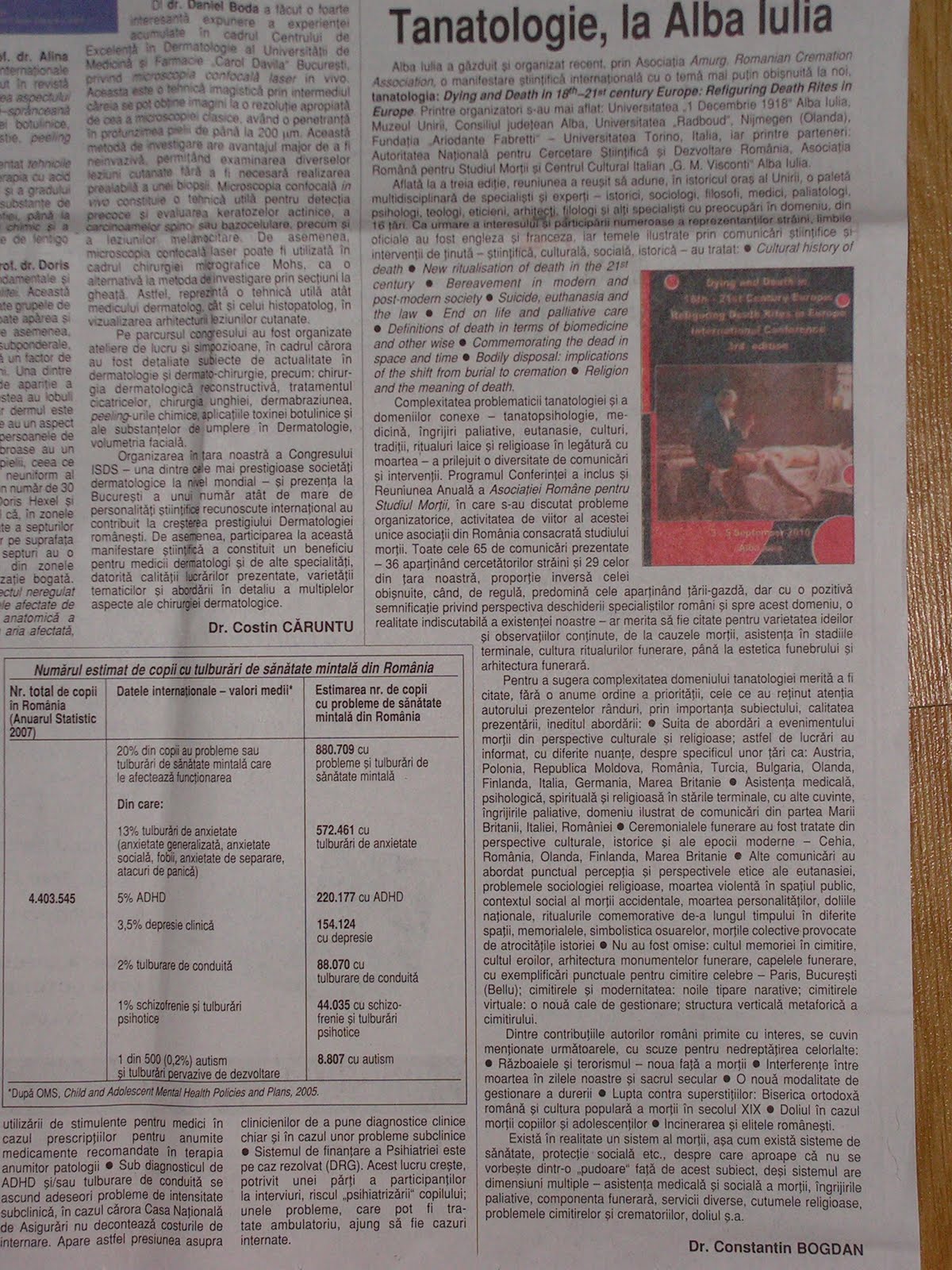 As you can read above "Viata Medicala" journal (41/2010) from Bucharest published a paper upon Dying and Death 03 conference. This is a great moment in the history of this conference because for the first time medical press from Romania emphasizes the importance of our conference. I'm really happy with this!
On the other hand we intend to use for our conference an abbreviation for its easier identification. At the Lucian Teodorescu's suggestion the proper abbreviation for Dying and Death in 18th-21st century Europe would be ABDD, namely Alba Iulia Dying and Death, followed by the number of the conference edition.
vineri, 8 octombrie 2010
Alcoholism02 International Conference
Alcoholism: Historical and Social Issues
International Conference, 2nd Edition
Alba Iulia, 13-16 October 2010
Programme
Organizers:
Alba County Council
National Museum of Unification Alba Iulia
„1 Decembrie 1918” University of Alba Iulia
Partners:
Centro Culturale Italiano „G.M. Visconti” Alba Iulia
Alba County Directorate for Culture and National Heritage
Tradition Group Alba Iulia
Sponsors:
Wednesday, 13th of October
Arrival and registration of the participants
Location: Vila Elisabeta
20.00 – Welcome Dinner at Vila Elisabeta
Thursday, 14th of October
9.30-10.15. Opening Ceremony
Location: Union Hall, National Museum of Unification
10.15-10.45. Coffee break
10.45-14.00. Guided historical visit - National Museum of Unification and the Three Fortifications Route (Dr. Tudor Roşu)
14.00-15.30. Lunch at Vila Elisabeta
15.30-16.00. Siesta
16.00-20.00 – First Session:
Medical, Psychological and Social Issues of Alcohol Consumption
Location: Vila Elisabeta
Chairman: Claudiu Ştefani
The presentations will last for 20 minutes, and 5 minutes are allocated for discussions at the end of each paper. Although it is desirable to follow the programme exactly, last time modifications may appear.
16.00-16.25 - Cristina Maria Speranza, Department of Clinical Psychology and Psychotherapies „Babes-Bolyai” University, Cluj-Napoca, Romania. (Coautor Medina Bordea) - The benefits of CBT (Cognitive Behavioral Therapy) and it's high rates of succes in people with alcohol problems
16.25-16.50 - Wilfried Koehler, Klinik für Abhängigkeitserkrankungen und Konsiliarpsychiatrie, Frankfurt am Main, Germany, Detoxification and motivational therapy of alcoholism in Germany
16.50-17.15 – Vlad Zeno Millea, University „1 Decembrie 1918” Alba Iulia, Romania, Attitudes regarding alcohol consumption; determinant factors and implication
17.15-17.30 – Coffee Break
17.30-17.55 - Claudiu Şimonaţi, County Turism Company of Hunedoara, Romania, Alcohol - Primary risk factor for oral cancer
17.55-18.20 - Creţeanu Olimpia, Pielmuş Cristina-Ionela, Law Court Turnu Măgurele, Romania - The Alcoholism effects on the Social Life
18.20-18.45 - Marian Suciu, „Babes-Bolyai” University of Cluj-Napoca, Romania - The Importance of the alcohol in the Society of East Asia
18.45-19.10 – Irina Takala, Petrozavodsk State University, Russia - Drinking as a Phenomenon of the Russian Culture
19.10-19.35 - Claudiu Ştefani, „1 Decembrie 1918” University of Alba Iulia, Romania - Influence of alcohol consumption over the risk bevaviors behind the wheel
19.35-20.00 – Eugen Băican, „Babeş-Bolyai” University of Cluj-Napoca, Romania -
20.15 – Dinner, Vila Elisabeta
Friday, 15th of October
9.00-13.00 – Second Session:
History of Alcohol Consumption and Alcoholism
Location: Vila Elisabeta
Chair: Judy Stove
9.00-9.25 - Dana Burian, „Babeş-Bolyai” University of Cluj-Napoca, Romania - Alcohol as a triggering factor for domestic violence in the second half of the nineteenth century in Transylvania
9.25-9.50 - Petar Atanackovic, Center for social researches and Alternative cultural organization, Novi Sad, Serbia - Alcohol and construction of social identities
9.50-10.15 - Marin Sâmbrian-Toma, University of Craiova, Romania - Pleasures of the body: a social history of drink in Wallachia (1700-1850)
10.15-10.40 - Costel Coroban, “Ovidius” University of Constanţa, Romania - Presbyterian & Jacobite Spirits in Early Modern Scotland
10.40-11.05 - Sidsel Eriksen, KØbenhavns Universitet, Denmark - ‘A disease of the rich?’ or ‘The rich men’s vice?’ – About preindustrial drinking
11.05-11.20 – Coffee Break
11.20-11.45 - Tudor Roşu, National Museum of Unification Alba Iulia, Romania - The Nationalist dimension in Romanian anti-alcoholism discourse untill the middle of the 20th Century
11.45-12.10 - Renée N. Lafferty, Brock University, Canada - The „Spirits” of Religion: Evangelicals and Medical Care for Toronto’s Dipsomaniacs, 1860-1890
12.10-12.35 – Iulia Adina Pop, “Babeş-Bolyai” University of Cluj-Napoca, Romania - The Hungarian Legislation over the Production and Consumption of Alcoholic Beverages During the Dual Monarchy
12.35-13.00 - Atilla Varga, Cluj-Napoca, Romania - Masonry, Good Templars and the Alcoholism in 19th-20th Century Trannsylvania
13.30-15.00 – Lunch, Vila Elisabeta
15.30-19.45 – Third Session:
History, Religion, Social Asspects
Location: „1 Decembrie 1918” University
Chairman: Sidsel Eriksen
15.30-15.55 - Marius Rotar, „1 Decembrie 1918” University of Alba Iulia, Romania - Romanian anti-alcoholism Journals
15.55-16.20 - Oana Tămaş, „Babeş-Bolyai” University of Cluj-Napoca, Romania - „Because the drunkness is spread among our people..”. The anti-alcoholic Romanian press at the end of the 19th and the beginning of the 20th Century
16.20-16.45 - Adrian Zandberg, Poland, „Down with the inn!” Polish temperance movement and the making of local prohibition (1920-1934)
16.45-17.10 – Monica Mureşan, „Babeş-Bolyai” University of Cluj-Napoca, Romania - The Problem of Alcoholism at the Romanian Clergy in Modern Transylvania
17.10-17.35 - Asztalos Ioan, „Lucian Blaga” University of Sibiu, Romania - The antialcoholic congress of Cernăuţi in 1927 – case study on the religious media in Sibiu
17.35-17.50 – Coffee Break
17.50-18.15 - Adriana Tămăşan, „Babeş-Bolyai” University of Cluj-Napoca, Romania - The alcohol in the Muslim religion
18.15-18.40 - Nadia Văcaru, „Al. I. Cuza” University, Iaşi, Romania - Alcoholism - stability factor disrupting Christian family in contemporary society
18.40-19.05 – Judith Stove, Australia, Alcohol, personal responsability, and the law: some recent Australian history
19.05-19.30 – Naima Khatoon, India
19.30-20.00 - Conclusions
20.30 – Dinner
Location:
sâmbătă, 2 octombrie 2010
My report to ANCS on Dying and Death 03 - in romanian language
Raport asupra celei de a treia ediţii a conferinţei internaţionale Dying and Death in 18th-21st century Europe: Refiguring Death Rites in Europe
Prezentare generală:
Cea de a treia ediţie a conferinţei internaţionale Dying and Death in 18th-21st century Europe: Refiguring Death Rites in Europe a fost organizată de către Universitatea 1 Decembrie 1918 din Alba Iulia, Muzeul Naţional al Unirii, Alba Iulia, Radboud University of Nijmejen, Olanda, Ariodante Fabretti Foundation, Universitatea din Torino, Italia. Partenerii acestui eveniment ştiinţific au fost Consiliul Judeţean Alba, Direcţia de Patrimoniu Alba Iulia şi ANCS, Amurg. Romanian Cremation Association, Romanian Association for Death Studies si Giovanni Morandi Visconti, Centrul Cultural Italian din Alba Iulia. Iniţial conferinţa a fost preconizată a fi organizată la Râmeţ în judeţul Alba, însă datorită numărului mare de participanţi şi a numărului scăzut de posibilităţi de cazare a acestora s-a luat decizia, de către comitetul organizatoric al conferinţei, mutarea acesteia. Astfel, conferinţa a avut loc între 3 şi 5 septembrie 2010 în Alba Iulia fiind găzduită de Universitatea “1 Decembrie 1918” şi de catre Muzeul Naţional al Unirii. Au participat 71 de cercetători din 15 ţări europene (Marea Britanie, Italia, Danemarca, Finlanda, Germania, Bulgaria, Grecia, Franţa, Turcia, Olanda, Republica Ceha, Polonia, Ucraina, Republica Moldova şi România) precum şi din Noua Zeelandă, reprezentând diverse institute şi universităţi de prestigiu. În total au fost reprezentate peste 35 de universităţi, institute de cercetare sau alte ONG şi asociaţii.
Au fost organizate şase secţiuni ştiinţifice ale conferinţei, care datorită numărului mare de comunicării au trebuit sa fie organizate în paralel în primele doua zile. Organizarea de secţiuni paralele a reprezentat o premieră în istoria conferinţei, aspect ce relevă creşterea interesului ştiinţific asupra acestui eveniment, atât în ţară cât şi în străinătate.
De asemenea la conferinţa au participat în premieră cercetători din state europene nereprezentate pana acum, element ce releva creşterea prestigiului conferinţei în mediile academice. Astfel, pentru prima dată au fost reprezentate state din spaţiul balcanic, Europa nordică şi de asemenea s-a întărit participarea din spaţiul ex-sovietic.
Conferinţa s-a bucurat de o reflectare bună la nivelul presei locale dar şi naţionale:
http://www.adevarul.ro/locale/alba_iulia/Alba-Iulia-Cercetatori-conferinta-internationala_0_328767536.html
http://www.ziare.com/alba-iulia/stiri-actualitate/conferinta-despre-moarte-a-reunit-la-alba-iulia-peste-70-de-participanti-1613287
http://www.stiriazi.ro/ziare/articol/articol/conferinta-despre-moarte-a-reunit-la-alba-iulia-peste--de-participanti/sumar-articol/2955987/
http://www.eziare.com/stire/conferinta-despre-moarte,361486.html
http://stiri.freshinfo.ro/pentru-studenti-conferinta-internationala-despre-bautura-si-moarte-s159992671.html
http://www.informatiadealba.ro/2010/09/conferinta-despre-moarte-a-reunit-la-alba-iulia-peste-70-de-participanti /
www.monitorulab.ro/cms/arch/m_ab/.../2008-09-01.html
Din păcate, autorităţile locale au ignorat acest eveniment, în ciuda amplorii sale, lucru subliniat şi în presă.
Importanţa conferinţei:
Dying and Death in 18th-21st century Europe, International Conference este unica manifestare dedicate tematicii din România şi centrul şi sud-estul Europei. Din această perspectivă organizarea cele de a treia ediţii reprezintă garanţia permanentizării acestui eveniment. Prin subiectul avut in atenţie conferinţa obligă la un dialog pluri si transdisciplinar. Cea mai simpla justificare a acestei afirmaţii constă în situaţia în care este imposibil a se analiza subiectul muririi si morţii prin prisma unei singure ştiinţe.Obiective avute in vedere:- conturarea unei noi reţele a cercetătorilor interesaţi asupra tematicii din Vestul, Estul, Centrul si Sud Estul Europei; dacă în cazul conferinţelor în domeniu organizate în Europa Occidentala se remarcă o participare aproape exclusivă a cercetătorilor din acest spaţiu geografic, Dying and Death in 18th-21st Century Europe, constituie cea mai buna punte de legătură între cercetătorii înteresaţi de subiect din întreaga Europa. Totodată, pentru prima data s-a înregistrat participarea din spatii non-europene, o alta dovada creşterii la nivel internaţional al acestei conferinţe.
- dezvoltarea studiilor de gen in România: dacă la precedentele ediţii ale conferinţei accentul a căzut pe o participare predominanta a mediului academic transilvănean, cea de a treia ediţie a înregistrat o participare deosebită de la diverse universităţi si institute din Bucureşti sau alte centre de cercetare din ţară.
- încurajarea dialogului interdisciplinar asupra tematicii, obiectiv realizat, conferinţa bucurându-se de participarea unor specialişti din diverse ramuri ale ştiinţei: istorici, sociologi, psihologi, medici, preoţi, filologi, asistenţi sociali, artişti (Golie Talaie, artist plastic din Olanda in acest an) sau filosofi ori, pe de altă parte, persoane direct implicate în industria funerară (Cosmin Bodrean, Brian Parsons); participarea doctorului Constantin Bogdan a constitute un punct în plus pentru nivelul conferinţei, domnia sa fiind preşedintele Societăţii Romane de Îngrijiri Paleative si Gerontologie, sub patronajul UNESCO.
- s-a urmărit la fel ca în cazul ediţiilor precedente sensibilizarea opiniei publice româneşti asupra importanţei tematicii muririi si morţii, datorită specificităţilor naţionale în domeniu.
- încercarea de implementare a unor modele vest europene în domeniu în România: spre exemplu serviciile de îngrijiri paliative (dictat şi de creşterea accentuată în ultimii ani a bolnavilor de cancer în România – obiectiv atins prin calitatea si numărul participanţilor la aceasta secţiune a conferinţei) sau a tanatologiei şi a sistemul death education (implementat în Occident prin diverse programe ale unor universităţi de prestigiu – de pildă, Center for Death and Society, Universitatea din Bath, Marea Britanie);
- încurajarea colaborării internaţionale în domeniu: obiectiv atins prin organizarea în cotutela cu Radboud University of Nijemgen, Olanda si Ariodante Fabretti Foudation, Universitatea din Torino, Italia a acestui eveniment
- încurajarea dezvoltării unor dezbateri polemice pe subiecte privind murirea şi moartea în România: euthanasia, sinucidere, tematica crematoriilor şi incinerărilor umane, ultima dintre acestea fiind considerată drept alternativă la rezolvarea crizei locurilor de veci din mediul urban românesc
- diseminarea rezultatelor sub forma editării unui volum al conferinţei: dacă până în acest an volum conferinţei a fost editat de sine stătător, din acest an proceedings-urile manifestării ştiinţifice de faţă au fost publicate ca supliment la Annales Universitatis Apulenis. Series Historica, revista indexata BDI, CEOOL. Situaţia de fata constituie un imbold esenţial în creşterea calitativă a manifestării ştiinţifice. De asemenea, aceasta împrejurare explică şi costurile mult mai ridicate implicate in editarea volumului conferinţei faţaă de ediţiile precedente. Se va încerca publicarea a doua articole din proceedings-uri conferinţei în jurnale ISI (Transylvanian Review)
Concluzii si propuneri pentru viitor:
- Obiectivele urmărite de către organizatorii conferinţei au fost atinse, chestiune demonstrata prin participarea extinsa din ţară şi din străinătate la aceasta manifestare ştiinţifică, multitudinea de subiecte atinse, cât şi prin reflectarea evenimentului la nivelul mass-mediei locale şi centrale. Publicarea volumul conferinţei asigura transparenţa demersului de fata. Din nefericire, datorită deadline-ului “scurt” nu toţi participanţii la conferinţă au reuşit să trimită în timp optim comunicările lor pentru publicarea acestora în volum. Ca urmare a creşterii prestigiului internaţional al conferinţei, Cambridge Scholar Publishing a propus tipărirea unei selecţii a unor lucrări susţinute şi publicate in cele trei ediţii ale conferinţei care sa apără sub forma unei cărţi ce va fi editată anul viitor. Astfel, vizibilitatea conferenţei va creste prin aceasta, în mod sensibil. Din cele peste 120 de articole publicate în volumele conferinţelor desfăşurate între 2008 şi 2009 vor fi selectate circa 20 pentru a fi publicate în această carte.
- De asemenea participanţii români la această conferinţă au decis în unanimitate revigorarea Asociaţiei Române pentru Studii asupra Morţii (RADS). Rostul acestei asociaţii este asigurarea unui nucleu divers de cercetători români asupra domeniului, traducerea pentru înţelesul publicului larg a politicilor sociale privind moartea în România, semnalarea deficienţelor actuale în sistemul românesc al morţii şi încurajarea organelor abilitate de a proceda la diverse modificări pentru îmbunătăţirea acestuia. Au fost aleşi ca membri ai consiliului de conducere ai acestei asociaţii: Marius Rotar – preşedinte, Victor Tudor Rosu – vicepreşedinte, Adriana Teodorescu – secretar.
- Din punct de vedere ştiinţific au fost discutate si analizate majoritatea subiecte presupuse de fenomenul muririi şi evenimentul morţii: analiza istorică a evoluţie atitudinilor în fata muririi si a morţii, a modalităţilor de dispunere asupra cadavrului (înhumare sau incinerare – ultimul dintre acestea fiind puţin răspândit în România); , bioetică, euthanasie, sinucidere, corelaţia boală-moartea în postmodernitate, subiectul îngrijirilor paliative, tematica literaturii (culturii), corelaţiile intre religie şi înţelesurile morţii etc. Ca o premiera a fost organizată o secţiune dedicate noilor ritualizării ale morţii in contemporaneitate, analizându-se tendinţe novatoare în domeniu.
- dimensiunea interdisciplinară, multiculturală, multietnică sau interconfesională este intrinseca acestei conferinţe. În consecinţă, dialogul purtat a fost deseori polemic, aspect ce a ridicat nivelul general al manifestării.
- La fel ca in ediţiile precedente la aceasta ediţiei s-a remarcat prezenta activa a unor persoane implicate În industria funerara la această conferinţă. Spre exemplu, Amurg. Romanian Cremation Association s-a implicat activ atât ca partener, cat şi ca sponsor principal al manifestării.
- Ca urmare a succesului deosebit al acestei ediţii a conferinţei s-a decis organizarea la un nivel a celei de a patra ediţii în ultima săptămână din septembrie 2011. De asemenea s-au demarat procedurile preliminare privind organizarea în premieră într-o ţară central sud est europeană, în speţă România, a celei mai importante conferinţe, pe plan mondial dedicate tematicii – Death and the Disposal of the Body pentru cea de a 11 ediţie preconizată ăn 2013. Pentru atingerea acestui scop, s-au iniţiat deja dialogurile cu Association for Death Studies, care patronează aceasta manifestare de mare prestigiu.
- cât priveşte posibilele modalităţi de creştere a conferinţei, este necesară pe viitor introducerea unei selecţii a participanţilor mult mai severă întrucât exista riscul de a se ajunge la o conferinţa cu peste 150 de participanţi, ceea ce implică costuri extrem de ridicate de suportat de către organizatori. De asemenea, comitetul organizatoric al conferinţei studiază posibilitatea de a introducere o taxa de participare minimă la conferinţă. În plus, una dintre cerinţele esenţiale ale conferinţei ar fi pe viitor implicarea si sensibilizarea mai activă a factorului deciziţional politic, pentru a i se semnala la nivel cat mai accentuat necesitatea reformei sistemului medical şi funerar din România. Se urmăreşte invitarea pentru ediţia următoare a conferinţei a unor membri ai Parlamentului României (spre exemplu senatorul UDMR Peter Lakatos – autorul proiectului noi legii a cimitirelor) sau a altor factori de decizie naţionali.
- In concluzie se poate considera ca a treia ediţie a Dying and Death in 18th-21st century Europe a fost cea mai reuşita dintre toate ediţiile acestei conferinţe, atât prin numărul si calitatea participanţilor si nivelul ştiinţific atins, precum si prin perspective care s-au deschis pentru dezvoltarea acestei manifestării si a unor colaborări internaţionale ulterioare.
Marius Rotar
Prezentare generală:
Cea de a treia ediţie a conferinţei internaţionale Dying and Death in 18th-21st century Europe: Refiguring Death Rites in Europe a fost organizată de către Universitatea 1 Decembrie 1918 din Alba Iulia, Muzeul Naţional al Unirii, Alba Iulia, Radboud University of Nijmejen, Olanda, Ariodante Fabretti Foundation, Universitatea din Torino, Italia. Partenerii acestui eveniment ştiinţific au fost Consiliul Judeţean Alba, Direcţia de Patrimoniu Alba Iulia şi ANCS, Amurg. Romanian Cremation Association, Romanian Association for Death Studies si Giovanni Morandi Visconti, Centrul Cultural Italian din Alba Iulia. Iniţial conferinţa a fost preconizată a fi organizată la Râmeţ în judeţul Alba, însă datorită numărului mare de participanţi şi a numărului scăzut de posibilităţi de cazare a acestora s-a luat decizia, de către comitetul organizatoric al conferinţei, mutarea acesteia. Astfel, conferinţa a avut loc între 3 şi 5 septembrie 2010 în Alba Iulia fiind găzduită de Universitatea “1 Decembrie 1918” şi de catre Muzeul Naţional al Unirii. Au participat 71 de cercetători din 15 ţări europene (Marea Britanie, Italia, Danemarca, Finlanda, Germania, Bulgaria, Grecia, Franţa, Turcia, Olanda, Republica Ceha, Polonia, Ucraina, Republica Moldova şi România) precum şi din Noua Zeelandă, reprezentând diverse institute şi universităţi de prestigiu. În total au fost reprezentate peste 35 de universităţi, institute de cercetare sau alte ONG şi asociaţii.
Au fost organizate şase secţiuni ştiinţifice ale conferinţei, care datorită numărului mare de comunicării au trebuit sa fie organizate în paralel în primele doua zile. Organizarea de secţiuni paralele a reprezentat o premieră în istoria conferinţei, aspect ce relevă creşterea interesului ştiinţific asupra acestui eveniment, atât în ţară cât şi în străinătate.
De asemenea la conferinţa au participat în premieră cercetători din state europene nereprezentate pana acum, element ce releva creşterea prestigiului conferinţei în mediile academice. Astfel, pentru prima dată au fost reprezentate state din spaţiul balcanic, Europa nordică şi de asemenea s-a întărit participarea din spaţiul ex-sovietic.
Conferinţa s-a bucurat de o reflectare bună la nivelul presei locale dar şi naţionale:
http://www.adevarul.ro/locale/alba_iulia/Alba-Iulia-Cercetatori-conferinta-internationala_0_328767536.html
http://www.ziare.com/alba-iulia/stiri-actualitate/conferinta-despre-moarte-a-reunit-la-alba-iulia-peste-70-de-participanti-1613287
http://www.stiriazi.ro/ziare/articol/articol/conferinta-despre-moarte-a-reunit-la-alba-iulia-peste--de-participanti/sumar-articol/2955987/
http://www.eziare.com/stire/conferinta-despre-moarte,361486.html
http://stiri.freshinfo.ro/pentru-studenti-conferinta-internationala-despre-bautura-si-moarte-s159992671.html
http://www.informatiadealba.ro/2010/09/conferinta-despre-moarte-a-reunit-la-alba-iulia-peste-70-de-participanti /
www.monitorulab.ro/cms/arch/m_ab/.../2008-09-01.html
Din păcate, autorităţile locale au ignorat acest eveniment, în ciuda amplorii sale, lucru subliniat şi în presă.
Importanţa conferinţei:
Dying and Death in 18th-21st century Europe, International Conference este unica manifestare dedicate tematicii din România şi centrul şi sud-estul Europei. Din această perspectivă organizarea cele de a treia ediţii reprezintă garanţia permanentizării acestui eveniment. Prin subiectul avut in atenţie conferinţa obligă la un dialog pluri si transdisciplinar. Cea mai simpla justificare a acestei afirmaţii constă în situaţia în care este imposibil a se analiza subiectul muririi si morţii prin prisma unei singure ştiinţe.Obiective avute in vedere:- conturarea unei noi reţele a cercetătorilor interesaţi asupra tematicii din Vestul, Estul, Centrul si Sud Estul Europei; dacă în cazul conferinţelor în domeniu organizate în Europa Occidentala se remarcă o participare aproape exclusivă a cercetătorilor din acest spaţiu geografic, Dying and Death in 18th-21st Century Europe, constituie cea mai buna punte de legătură între cercetătorii înteresaţi de subiect din întreaga Europa. Totodată, pentru prima data s-a înregistrat participarea din spatii non-europene, o alta dovada creşterii la nivel internaţional al acestei conferinţe.
- dezvoltarea studiilor de gen in România: dacă la precedentele ediţii ale conferinţei accentul a căzut pe o participare predominanta a mediului academic transilvănean, cea de a treia ediţie a înregistrat o participare deosebită de la diverse universităţi si institute din Bucureşti sau alte centre de cercetare din ţară.
- încurajarea dialogului interdisciplinar asupra tematicii, obiectiv realizat, conferinţa bucurându-se de participarea unor specialişti din diverse ramuri ale ştiinţei: istorici, sociologi, psihologi, medici, preoţi, filologi, asistenţi sociali, artişti (Golie Talaie, artist plastic din Olanda in acest an) sau filosofi ori, pe de altă parte, persoane direct implicate în industria funerară (Cosmin Bodrean, Brian Parsons); participarea doctorului Constantin Bogdan a constitute un punct în plus pentru nivelul conferinţei, domnia sa fiind preşedintele Societăţii Romane de Îngrijiri Paleative si Gerontologie, sub patronajul UNESCO.
- s-a urmărit la fel ca în cazul ediţiilor precedente sensibilizarea opiniei publice româneşti asupra importanţei tematicii muririi si morţii, datorită specificităţilor naţionale în domeniu.
- încercarea de implementare a unor modele vest europene în domeniu în România: spre exemplu serviciile de îngrijiri paliative (dictat şi de creşterea accentuată în ultimii ani a bolnavilor de cancer în România – obiectiv atins prin calitatea si numărul participanţilor la aceasta secţiune a conferinţei) sau a tanatologiei şi a sistemul death education (implementat în Occident prin diverse programe ale unor universităţi de prestigiu – de pildă, Center for Death and Society, Universitatea din Bath, Marea Britanie);
- încurajarea colaborării internaţionale în domeniu: obiectiv atins prin organizarea în cotutela cu Radboud University of Nijemgen, Olanda si Ariodante Fabretti Foudation, Universitatea din Torino, Italia a acestui eveniment
- încurajarea dezvoltării unor dezbateri polemice pe subiecte privind murirea şi moartea în România: euthanasia, sinucidere, tematica crematoriilor şi incinerărilor umane, ultima dintre acestea fiind considerată drept alternativă la rezolvarea crizei locurilor de veci din mediul urban românesc
- diseminarea rezultatelor sub forma editării unui volum al conferinţei: dacă până în acest an volum conferinţei a fost editat de sine stătător, din acest an proceedings-urile manifestării ştiinţifice de faţă au fost publicate ca supliment la Annales Universitatis Apulenis. Series Historica, revista indexata BDI, CEOOL. Situaţia de fata constituie un imbold esenţial în creşterea calitativă a manifestării ştiinţifice. De asemenea, aceasta împrejurare explică şi costurile mult mai ridicate implicate in editarea volumului conferinţei faţaă de ediţiile precedente. Se va încerca publicarea a doua articole din proceedings-uri conferinţei în jurnale ISI (Transylvanian Review)
Concluzii si propuneri pentru viitor:
- Obiectivele urmărite de către organizatorii conferinţei au fost atinse, chestiune demonstrata prin participarea extinsa din ţară şi din străinătate la aceasta manifestare ştiinţifică, multitudinea de subiecte atinse, cât şi prin reflectarea evenimentului la nivelul mass-mediei locale şi centrale. Publicarea volumul conferinţei asigura transparenţa demersului de fata. Din nefericire, datorită deadline-ului “scurt” nu toţi participanţii la conferinţă au reuşit să trimită în timp optim comunicările lor pentru publicarea acestora în volum. Ca urmare a creşterii prestigiului internaţional al conferinţei, Cambridge Scholar Publishing a propus tipărirea unei selecţii a unor lucrări susţinute şi publicate in cele trei ediţii ale conferinţei care sa apără sub forma unei cărţi ce va fi editată anul viitor. Astfel, vizibilitatea conferenţei va creste prin aceasta, în mod sensibil. Din cele peste 120 de articole publicate în volumele conferinţelor desfăşurate între 2008 şi 2009 vor fi selectate circa 20 pentru a fi publicate în această carte.
- De asemenea participanţii români la această conferinţă au decis în unanimitate revigorarea Asociaţiei Române pentru Studii asupra Morţii (RADS). Rostul acestei asociaţii este asigurarea unui nucleu divers de cercetători români asupra domeniului, traducerea pentru înţelesul publicului larg a politicilor sociale privind moartea în România, semnalarea deficienţelor actuale în sistemul românesc al morţii şi încurajarea organelor abilitate de a proceda la diverse modificări pentru îmbunătăţirea acestuia. Au fost aleşi ca membri ai consiliului de conducere ai acestei asociaţii: Marius Rotar – preşedinte, Victor Tudor Rosu – vicepreşedinte, Adriana Teodorescu – secretar.
- Din punct de vedere ştiinţific au fost discutate si analizate majoritatea subiecte presupuse de fenomenul muririi şi evenimentul morţii: analiza istorică a evoluţie atitudinilor în fata muririi si a morţii, a modalităţilor de dispunere asupra cadavrului (înhumare sau incinerare – ultimul dintre acestea fiind puţin răspândit în România); , bioetică, euthanasie, sinucidere, corelaţia boală-moartea în postmodernitate, subiectul îngrijirilor paliative, tematica literaturii (culturii), corelaţiile intre religie şi înţelesurile morţii etc. Ca o premiera a fost organizată o secţiune dedicate noilor ritualizării ale morţii in contemporaneitate, analizându-se tendinţe novatoare în domeniu.
- dimensiunea interdisciplinară, multiculturală, multietnică sau interconfesională este intrinseca acestei conferinţe. În consecinţă, dialogul purtat a fost deseori polemic, aspect ce a ridicat nivelul general al manifestării.
- La fel ca in ediţiile precedente la aceasta ediţiei s-a remarcat prezenta activa a unor persoane implicate În industria funerara la această conferinţă. Spre exemplu, Amurg. Romanian Cremation Association s-a implicat activ atât ca partener, cat şi ca sponsor principal al manifestării.
- Ca urmare a succesului deosebit al acestei ediţii a conferinţei s-a decis organizarea la un nivel a celei de a patra ediţii în ultima săptămână din septembrie 2011. De asemenea s-au demarat procedurile preliminare privind organizarea în premieră într-o ţară central sud est europeană, în speţă România, a celei mai importante conferinţe, pe plan mondial dedicate tematicii – Death and the Disposal of the Body pentru cea de a 11 ediţie preconizată ăn 2013. Pentru atingerea acestui scop, s-au iniţiat deja dialogurile cu Association for Death Studies, care patronează aceasta manifestare de mare prestigiu.
- cât priveşte posibilele modalităţi de creştere a conferinţei, este necesară pe viitor introducerea unei selecţii a participanţilor mult mai severă întrucât exista riscul de a se ajunge la o conferinţa cu peste 150 de participanţi, ceea ce implică costuri extrem de ridicate de suportat de către organizatori. De asemenea, comitetul organizatoric al conferinţei studiază posibilitatea de a introducere o taxa de participare minimă la conferinţă. În plus, una dintre cerinţele esenţiale ale conferinţei ar fi pe viitor implicarea si sensibilizarea mai activă a factorului deciziţional politic, pentru a i se semnala la nivel cat mai accentuat necesitatea reformei sistemului medical şi funerar din România. Se urmăreşte invitarea pentru ediţia următoare a conferinţei a unor membri ai Parlamentului României (spre exemplu senatorul UDMR Peter Lakatos – autorul proiectului noi legii a cimitirelor) sau a altor factori de decizie naţionali.
- In concluzie se poate considera ca a treia ediţie a Dying and Death in 18th-21st century Europe a fost cea mai reuşita dintre toate ediţiile acestei conferinţe, atât prin numărul si calitatea participanţilor si nivelul ştiinţific atins, precum si prin perspective care s-au deschis pentru dezvoltarea acestei manifestării si a unor colaborări internaţionale ulterioare.
Marius Rotar
luni, 27 septembrie 2010
Adrian Nastase's opinion upon Dying and Death 03 conference
Adrian Nastase, the former prime minister of Romania, mentioned on his blog something about Dying and Death in 18th-21st century Europe: Refiguring Death Rites in Europe, International Conference. He was ironic with the general topic of our conference and also he tried to criticize his political enemies mentioning our conference:
"Cu toate ca, probabil, o sa vi se para un inceput prea morbid al acestei sectiuni, va anunt ca au existat doua stiri ale caror informatii mi-au ramas intiparite in minte zilele anterioare. Nu, nu este vorba despre remanierea guvernamentala, asa cum nu este vorba nici despre bataile la usa mamei unui anumit fost ministru al dinastiei Boc 4.
Primul subiect vorbea despre faptul ca in week-end, la Alba Iulia, a avut loc cea de-a treia editie a conferintei internationale “Dying and Death in 18th-21st century Europe: Refiguring Death Rites in Europe”. Conform spuselor organizatorilor, evenimentul organizat in Romania este, citez, unic in Centrul si Sud Estul Europei. O prima concluzie? Pana si moartea se simte la ea acasa, unica si in centrul atentiei in Romania…
De cealalta parte, o alta stire, din acelasi flux, anunta faptul ca ministrul Educatiei este asteptat, culmea, tot la Alba Iulia la sfarsit de saptamana. Involuntar, fara o lectura prealabila a textului din urma, am facut o legatura malitioasa, ce-i drept, intre Congresul International si vizita lui Daniel Funeriu. Vizita care, nu in contextual remanierii, repet, ci in acela al ramanerii demne a domniei sale in functie (Ministerul Educatiei este cel mai vaduvit de fonduri minister in urma rectificarii bugetare, iar dascalii sunt cea mai umilita categorie sociala a Romaniei, alaturi de medici, de catre Traian Basescu), ar fi putut avea o prezentare la congresul mai sus-mentionat, cu titlul Moartea sistemului educational romanesc". (http://nastase.wordpress.com/2010/09/12/raspunsuri-vechi/#comment-106992 )
I fully understand the jokes and the ironies and I dolove these but I think Adrian Nastase minimizes our effort to organize this conference, taking into the laughter the conference.
This is my comment upon it on his blog approved already by him:
"Domnule Adrian Nastase,
Imi cer scuze ca va raspund asa de tarziu la ceea ce ati scris pe blogul dvs. legat de conferinta. In calitate de initiator si organizator principal al manifestari mentionate, nu pot decat sa-mi exprim regretul fata de aprecierile pe care le-ati facut. Inteleg ironia si umorul, insa in acest caz nu-si au avut rostul, intrucat vorbim despre un eveniment stiintific de inalta tinuta, unic intr-adevar in partea asta de lume. Nu ma apuc sa va vorbesc despre relevanta sa si nici nu va dau diverse linkuri care v-ar edifica asupra interesului academic existent de decenii bune asupra tematicii. Ar fi o pierdere de vreme. Vreau doar sa va spun ca, din pacate, vorba unui coleg, atunci cand organizezi un astfel de eveniment, dupa ce se incheie, realizezi, in calitate de cercetator, ca nu mai ai bani cu ce sa-ti platesti gazu’ fiind nevoit, de cele mai multe ori, sa pui bani din buzunar pentru organizare. Asta apropo de sprijinul autoritorilor locale si centrale. Iar ca satisfactie profesionala nu primesti de multe ori decat aprecieri hazlii la adresa muncii depuse.
Va stau oricand la dispozitie cu amanunte despre aceasta conferinta, ajunsa in acest an la a treia editie si care in 2010 a adunat cercetatori din 16 tari. De asemenea va pot trimite proceedings-urile conferintei din acest an, pentru a vedea ca ironiile dvs. nu isi au rostul. Proceedings-urile sunt indexate BDI si sper ca anul viitor sa le indexam ISI.
Puteti vizita blogul meu: http://www.romaniandeathcremation.blogspot.com pentru a va lamuri si mai bine despre ce a fost vorba.
Va putem invita anul viitor sa participati si sa vedeti, spre exemplu, dimenisiunile reale ale crizei in sistemul mortii din Romania (slaba dezvoltare a serviciilor de ingrijiri paliative, criza locurilor de veci in mediul urban, lipsa de reforma a sistemului funerar romanesc etc.)
Va multumesc!
Cu respect,
Marius Rotar" (http://nastase.wordpress.com/2010/09/12/raspunsuri-vechi/#comment-106992 )
Anyway it is a honor that my blog was mentioned on Adrian Nastase's blog and I'm not sad by his opinion.
"Cu toate ca, probabil, o sa vi se para un inceput prea morbid al acestei sectiuni, va anunt ca au existat doua stiri ale caror informatii mi-au ramas intiparite in minte zilele anterioare. Nu, nu este vorba despre remanierea guvernamentala, asa cum nu este vorba nici despre bataile la usa mamei unui anumit fost ministru al dinastiei Boc 4.
Primul subiect vorbea despre faptul ca in week-end, la Alba Iulia, a avut loc cea de-a treia editie a conferintei internationale “Dying and Death in 18th-21st century Europe: Refiguring Death Rites in Europe”. Conform spuselor organizatorilor, evenimentul organizat in Romania este, citez, unic in Centrul si Sud Estul Europei. O prima concluzie? Pana si moartea se simte la ea acasa, unica si in centrul atentiei in Romania…
De cealalta parte, o alta stire, din acelasi flux, anunta faptul ca ministrul Educatiei este asteptat, culmea, tot la Alba Iulia la sfarsit de saptamana. Involuntar, fara o lectura prealabila a textului din urma, am facut o legatura malitioasa, ce-i drept, intre Congresul International si vizita lui Daniel Funeriu. Vizita care, nu in contextual remanierii, repet, ci in acela al ramanerii demne a domniei sale in functie (Ministerul Educatiei este cel mai vaduvit de fonduri minister in urma rectificarii bugetare, iar dascalii sunt cea mai umilita categorie sociala a Romaniei, alaturi de medici, de catre Traian Basescu), ar fi putut avea o prezentare la congresul mai sus-mentionat, cu titlul Moartea sistemului educational romanesc". (http://nastase.wordpress.com/2010/09/12/raspunsuri-vechi/#comment-106992 )
I fully understand the jokes and the ironies and I dolove these but I think Adrian Nastase minimizes our effort to organize this conference, taking into the laughter the conference.
This is my comment upon it on his blog approved already by him:
"Domnule Adrian Nastase,
Imi cer scuze ca va raspund asa de tarziu la ceea ce ati scris pe blogul dvs. legat de conferinta. In calitate de initiator si organizator principal al manifestari mentionate, nu pot decat sa-mi exprim regretul fata de aprecierile pe care le-ati facut. Inteleg ironia si umorul, insa in acest caz nu-si au avut rostul, intrucat vorbim despre un eveniment stiintific de inalta tinuta, unic intr-adevar in partea asta de lume. Nu ma apuc sa va vorbesc despre relevanta sa si nici nu va dau diverse linkuri care v-ar edifica asupra interesului academic existent de decenii bune asupra tematicii. Ar fi o pierdere de vreme. Vreau doar sa va spun ca, din pacate, vorba unui coleg, atunci cand organizezi un astfel de eveniment, dupa ce se incheie, realizezi, in calitate de cercetator, ca nu mai ai bani cu ce sa-ti platesti gazu’ fiind nevoit, de cele mai multe ori, sa pui bani din buzunar pentru organizare. Asta apropo de sprijinul autoritorilor locale si centrale. Iar ca satisfactie profesionala nu primesti de multe ori decat aprecieri hazlii la adresa muncii depuse.
Va stau oricand la dispozitie cu amanunte despre aceasta conferinta, ajunsa in acest an la a treia editie si care in 2010 a adunat cercetatori din 16 tari. De asemenea va pot trimite proceedings-urile conferintei din acest an, pentru a vedea ca ironiile dvs. nu isi au rostul. Proceedings-urile sunt indexate BDI si sper ca anul viitor sa le indexam ISI.
Puteti vizita blogul meu: http://www.romaniandeathcremation.blogspot.com pentru a va lamuri si mai bine despre ce a fost vorba.
Va putem invita anul viitor sa participati si sa vedeti, spre exemplu, dimenisiunile reale ale crizei in sistemul mortii din Romania (slaba dezvoltare a serviciilor de ingrijiri paliative, criza locurilor de veci in mediul urban, lipsa de reforma a sistemului funerar romanesc etc.)
Va multumesc!
Cu respect,
Marius Rotar" (http://nastase.wordpress.com/2010/09/12/raspunsuri-vechi/#comment-106992 )
Anyway it is a honor that my blog was mentioned on Adrian Nastase's blog and I'm not sad by his opinion.
duminică, 26 septembrie 2010
Conference Proceedings 2010
For conference proceedings 2010 we received about 42 papers. This is a good overall taking into account the participants' number at the conference. Right now I'm hardly working on my report which I have to send to ANCS, Romania. I will publish this report on my blog.
Also, Cambridge Scholars Publishing proposed to me to edit a book with some selected papers from all the editions of Dying and Death in 18th-21st century Europe, international conference. I think they and I will select maximum 20 papers for this book.
Also, Cambridge Scholars Publishing proposed to me to edit a book with some selected papers from all the editions of Dying and Death in 18th-21st century Europe, international conference. I think they and I will select maximum 20 papers for this book.
joi, 16 septembrie 2010
Thomas Quartier in action at karaoke party of Dying and Death 03, Alba Iulia 2010 !
He is best singer at our conference's karaoke party, performing Bob Dylan!
miercuri, 15 septembrie 2010
Me performing Luminita Anghel's Let me try at Dying and Death 03 conference
This is a very serious reason to laugh! Enjoy!
sâmbătă, 11 septembrie 2010

miercuri, 8 septembrie 2010
Pictures + ELVIS
 At Ramet Monastery
Some of the conference's participants (without italian team and other participants from UK, Denmark, Finland, Greece, Romania, too)
Elvis at Dying and Death III conference
Pictures
 Cremation team (Peter C. Jupp, Zdenek Nespor, Hilary Grainger, Mihaela Bodrean, Brian Parsons, Marius Rotar)
 Elvis never dies!
 Me perfoming Luminita Anghel's Let me try
 My daughter at Ramet monastery
 Cyrill Nespor (Czech Republic) - the youngest participant at the conference
 Conclusions' moment
Here are some pictures taken by me at the third edition of Dying and Death in 18th-21st century Europe, Alba Iulia, Romania, 3-5 of september 2010. I will post other pictures later. Stay here for this!
luni, 6 septembrie 2010
Thank you!
On behalf of organizers and the organizing team of "Dying and Death in 18-21st century Europe: Refiguring Death Rites in Europe", International Conference I wish to THANK YOU for your participation and your contribution at our conference. I think our conference was a great moment.
Here is the Rocky:
http://www.youtube.com/watch?v=IWR0k_R6XDE
In few days I will post here some pictures taken by.
See you very soon!
Here is the Rocky:
http://www.youtube.com/watch?v=IWR0k_R6XDE
In few days I will post here some pictures taken by.
See you very soon!
sâmbătă, 28 august 2010
The Final Programme
Thursday, September 2
20:00 – Welcome Dinner
Location: Platoul Romanilor Restaurant
Friday, September 3
9:15 – Opening Ceremony
Location: Union Hall, National Museum of Unification
Speakers:
• Moise Ioan Achim – President of “1 Decembrie 1918” University of Alba Iulia, Romania
• Ion Dumitrel – President of Alba County, Romania
• Gabriel Rustoiu – Director of National Museum of Unification, Alba Iulia, Romania
• Marina Sozzi - Ariodante Fabretti Foundation, University of Turin (Italy)
• Peter C. Jupp – University of Bristol (UK)
• Eric Venbrux – Radboud University Nijmegen (The Netherlands)
• Gianfranco Fracarollo - Director of “Giovanni Morando Visconti” Italian Cultural Center of Alba Iulia (Romania)
• Cosmin Bodrean – Vice president of Amurg. Romanian Cremation Association (Romania)
• Victor Tudor Roşu – National Museum of Unification, Alba Iulia (Romania)
• Marius Rotar – “1 Decembrie 1918” University of Alba Iulia
10:15 – 10:30 – Coffee Break
10:30 – 13:30 – Session 1: Cultural History of Death
Location: Apor Palace
Chair: Ştefan Borbély
• Diarmuid Johnson (Poland –UK), Attitudes Towards Death and Dying in the Oral and Written Literatures of the Celtic Languages since the 18th Century
• Václav Grubhoffer (Czech Republic), Dying, death and funeral ceremonies of Austrian aristocracy in the 19th century Habsburg Monarchy. (An example of the Schwarzenberg family)
• Alina Felea (Republic of Moldova), Some Information on the Image of Death in 18th century Moldova
• Nicolae Mihai (Romania), Lutter contre les superstitions: Eglise orthodoxe roumaine et la culture populaire de la mort au milieu du XIXe siècle
• Mihai Chiper (Romania), Honor and Death in the Militarist Discourse, Romania 1859-1918
• Raluca Betea (Romania), Visual Representations of Death between Production and Reception.
A Case-Study on the Romanian Churches in Maramureş (18th-19th Century)
10:30 – 13:30 – Session 2: Commemoration of the dead in space and time
Location: Aula Magna room, “1 Decembrie 1918” University of Alba Iulia
Chair: Ken Worpole
• Virgiliu Birladeanu (Republic of Moldova), The Victims of Tweeter revolution: from Justice to Commemoration
• Emiliya Karaboeva (Bulgaria) Commemorating the dead. Bulgarian street necrologs in comparative perspective
• Emilie Jaworski (France), Commémorations et deuils nationaux en Pologne. Entre héritage symbolique et nouvelles réalités sociales
• Malgorzata Zawila (Poland), Missing the Heroes
• Olga Nesporova, (Czech Republic), New Phenomena: Roadside Memorials
• Irina Stahl (Romania), Les croix de la ville de Bucarest. Problèmes de sociologie religieuse
• Bogdan Neagota, Ileana Benga (Romania) Ritual Happening and Personal Experience Within the Narrative-Ceremonial Funerary Complex. Case Studies from Caras-Severin and Arges counties
13:30 – 15:30 – Lunch
Location: Pub 13 Restaurant offer by Amurg. Romanian Cremation Association)
15:45 – 17:15 – Session 1: Cultural History of Death
Location: Apor Palace
Chair: Marina Sozzi
• Florenţa Popescu-Simion (Romania), Crosses on the roads– Romanian marks of violent deaths in the public space
• Cristinel Roman-Negoi, Ana Maria Roman Negoi (Romania), Maria Theresa and horses. The legend of the empress’s death in the Romanian contemporary mindset
• Gevher Gökçe Acar (Turkey), Two different cultures, two different approaches on death-place relationship – death cult and cemeteries in Vienna and Istanbul in the 18th and 19th centuries
• Adriana Teodorescu (Romania), The Death of the Star. Social and Cultural Issues
15:45 – 17:15 – Session 2: Commemorations and the Space of the Dead
Location: Aula Magna room, “1 Decembrie 1918” University of Alba Iulia
Chair: Christine Schlott
• Ludmila Cojocari (Republic of Moldova), May 9 in the republic of Moldova (2001-2009): between the commemoration of Victory and cult of the dead
• Nikolay Vukov (Bulgaria), Collective Interments: Ossuaries and Brotherly Mounds in Bulgaria After 1944
• Olga Gradinaru (Romania), Two Deaths and Two Destinies: Rasputin and the Imperial Russia
• Golie Tataie (The Netherlands), A Transatlantic Love. On Photography and Memory
17:15 – 17:30 – Coffee Break
17:30 – 19:40 – Session 1: Cultural History of Death
Location: Apor Palace
Chair: Cyrill Schaffer
• Victor Tudor Roşu (Romania), The representations of American stars’ death in communist Romania
• Ştefan Borbély (Romania), Death and Work. Or: Death by Work? A Classical Case Study: Marx
• Laura Jiga Iliescu (Romania) Few considerations about the power of the ironsmith, as expressed in the ATU 331 and ATU 753 narratives
• Anna Kubiak (Poland), Atrocities of von Hagens and sacrifice’s crisis
• Claudiu Stefani (Romania), Social context of accidental dead. A content analysis of newspaper coverage
17:30 – 19:40 – Session 2: End of Life and Palliative Cares. Bereavement
Location: Aula Magna room, “1 Decembrie 1918” University of Alba Iulia
Chair: Maria Xenaki
• Ken Worpole (UK), THE MODERN HOSPICE MOVEMENT: A QUIET REVOLUTION IN END OF LIFE CARE
• Constantin Bogdan (Romania), A complex approach and Therapy End of life - doctors, moral, social, spiritual - Palliative Care
• Cristina Maria Speranza, Bordea Medina, (Romania), Bereavement in children and adolescents
• Veronese S., Gallo G., Valle A., Rivoiro C., Oliver D.J (Italy), Specialist Palliative Care Service for People Severely Affected By Neurodegenerative Conditions: Does This Make a Difference To Palliative Care Outcomes? Results Of Ne-Pal - An Explorative Randomized Controlled Tria.
• Désirée Boschetti, Barbara Ottaviani (Italy), Awareness of Terminality, Criteria for the psychological investigation of levels of awareness of terminality in cancer patients
P. Varese, N. Volgarino, P. Bellingeri, S. Bellinceri, M.Musso (Italy), CIGNO philosophy and the treatment of mourning
20:00 –Dinner
Location: Preciosa Restaurant
21:30 –Karaoke Party (optional)
Location: Preciosa Restaurant
Saturday, September 4
09:00 – 10:50 – Session 1: New Ritualisation of Death in 21th century
Location: Apor Palace
Chair: Thomas Quartier
• Eric Venbrux (The Netherlands), Mission Accomplished: Notions of Life in Dutch Funerary Culture
• Florina Codreanu (Romania) Death Lessons in the Imaginary Delivered by Computer Games Industry
• Monica Alina Danci (Romania), Love, Death and Everyday Life
• Ilona Kemppainen (Finland), Death and modernization
• Adela Toplean (Romania), Crossroads between Modern Death and Secular Sacred
09:00 – 10:50 – Session 2: End of Life and Palliative Cares. Bereavement
Location: Aula Magna room, “1 Decembrie 1918” University of Alba Iulia
Chair: Anne Markussen
• Constantin Bogdan (Romania), To die today
• Maria Xenaki (Greece-UK), Grieving alone? Towards an understanding of the experience of bereaved single parents: An interpretative phenomenological analysis
• Ioana Todor, Lucian Marina (Romania), Perception on the Ethical Perspective of Euthanasia
• Birgitte Koch (Denmark), Palliative Cares in Denmark
10:50-11:05 – Coffee Break
11:05 – 13:30 – Session 1: New Ritualisation of Death in 21th century
Location: Aula Magna room, “1 Decembrie 1918” University of Alba Iulia
Chair: Eric Venbrux
• Christine Schlott (Germany), Undertaker in Leipzig (Germany) – Ritual Specialists in Secular Time
• R. Becarelli, E. Locatelli, M. Sozzi (Italy), Contemporary features of death: a research over 52 mortuary chapels of health structures in Piedmont, Italy
• Thomas Quartier (The Netherlands), Personalized eschatology. Crossing the border of death in Dutch mourning rituals
• Cyrill Schaffer (New Zealand), Corpses, Conflict and Culture: An Analysis of Colonial Post-Mortem Practices
• Oana Elena Branda (Romania), War on terror: the new face of death
• Luigi Bartolomei (Italy), New architectures for funeral houses in the contemporary secularized italian society
• Antonella Grossi (Italy), Dans les « jardins du souvenir ». Expérience de la mémoire dans les cimetières de Paris. Premières notes de terrain
11:05 – 13:30 – Session2: Bodily disposal: implications of the shift from burial to cremation
Location: Apor Palace
Chair: Julie Rugg
• Anne Markussen (Denmark), Inverse Cremation and organ donation rates / Taking another Look at Bodily Disposal and Religion
• Brian Parsons (UK), European Influences on the Development of Cremation in Great Britain
• Revd Dr Peter C. Jupp (UK), Inverness crematorium: a challenge to the Highland way of death?
• Marius Rotar (Romania), The issues of cremation and the Romanian elites (19th-21st century)
• Hilary Grainger (UK), A Modernist Architectural Expression of Cremation: A Scottish Perspective
• Zdeněk R. Nešpor, (Czech Republic), Building of Crematoria in the Czech Republic: Social and Ideological Issue
13:30 – 15:00 – Lunch
Location: Platoul Romanilor Restaurant
16:00 – 19:00 – Trip at Bucerdea Vinoasa
20:00 – 23:00 – Romanian Traditional Meal
Location: Bucerdea Vinoasa
Sunday 5 September
8:20-9:00 – The annual meeting of Romanian Association for Death Studies *only for Romanian participants
09:00 – 11:15 – Session 1: Bodily disposal: implications of the shift from burial to cremation
Location: Apor Palace
Chair: Hilary Grainger
• Mirjam Klaassens (The Netherlands), Natural burial in the Netherlands
• Claudia Ionescu (Romania), Ekphrastic Representations of Death in Bellu Orthodox Cemetery in Bucharest
• Julie Rugg (UK), Cemeteries and modernity: new narrative frameworks
• Olivia Ministeri (Italy), Virtual cemeteries. A new way of grief processing?
• Marianna Nitu (Romania), The vertical metaphoric structure of the cemetery
• Andreea Pop (Romania), Forgotten Heritage of Memory and Commemoration - assemblies and funerary monuments in Romania
11:15-11:30 – Coffee Break
11:30 – 13:00 – Session2: Religion and The Meaning of Death
Location: Apor Palace
Chair: Peter C. Jupp
• Sergiy V. Kurbatov (Ukraine), Death as a Factor of Creation the Cultural Reality: the Cases of Socrates and Hamlet
• Josef Schovanec (Czech Republic), The East in the West: death and new religions – the example of Bahai faith and Theosophy
• Bożena Józefów (Poland), Other World – Relics of the Pagan Belief in Polish Folk Culture
• Constantin Mihai (Romania), Sur la vie et sur la mort. Être en Christ dans la théologie de Saint Paul
• Corneliu Simuţ (Romania), Learning How to Die. Attitudes towards Death in Vito Mancuso’s Catholic Radicalism
Conclusions: 13:10-13:30
13:30 – 15:00 – Lunch
Location: Hotel Parc, offer by “Giovanni Morando Visconti” Italian Cultural Center of Alba Iulia
16:00 – 18:30 – Trip -Visitation of Ramet Monastery
19:30 – Dinner
Location: Hotel Parc, offer by “Giovanni Morando Visconti” Italian Cultural Center of Alba Iulia
Other information:
If you have some problems during your staying in Romania you could contact me on phone at 0040731030124 or my collegue Victor Tudor Rosu at 0040724072655.
We will pick up you from airport but if you have to wait for cars in the aiport for a while don't worry. The cars will pick up from airports not just one conference participant.
Remember: you have 15 minutes for your paper presentation followed by 5-7 minutes for questions and answers. You could use PowerPoint presentation.
20:00 – Welcome Dinner
Location: Platoul Romanilor Restaurant
Friday, September 3
9:15 – Opening Ceremony
Location: Union Hall, National Museum of Unification
Speakers:
• Moise Ioan Achim – President of “1 Decembrie 1918” University of Alba Iulia, Romania
• Ion Dumitrel – President of Alba County, Romania
• Gabriel Rustoiu – Director of National Museum of Unification, Alba Iulia, Romania
• Marina Sozzi - Ariodante Fabretti Foundation, University of Turin (Italy)
• Peter C. Jupp – University of Bristol (UK)
• Eric Venbrux – Radboud University Nijmegen (The Netherlands)
• Gianfranco Fracarollo - Director of “Giovanni Morando Visconti” Italian Cultural Center of Alba Iulia (Romania)
• Cosmin Bodrean – Vice president of Amurg. Romanian Cremation Association (Romania)
• Victor Tudor Roşu – National Museum of Unification, Alba Iulia (Romania)
• Marius Rotar – “1 Decembrie 1918” University of Alba Iulia
10:15 – 10:30 – Coffee Break
10:30 – 13:30 – Session 1: Cultural History of Death
Location: Apor Palace
Chair: Ştefan Borbély
• Diarmuid Johnson (Poland –UK), Attitudes Towards Death and Dying in the Oral and Written Literatures of the Celtic Languages since the 18th Century
• Václav Grubhoffer (Czech Republic), Dying, death and funeral ceremonies of Austrian aristocracy in the 19th century Habsburg Monarchy. (An example of the Schwarzenberg family)
• Alina Felea (Republic of Moldova), Some Information on the Image of Death in 18th century Moldova
• Nicolae Mihai (Romania), Lutter contre les superstitions: Eglise orthodoxe roumaine et la culture populaire de la mort au milieu du XIXe siècle
• Mihai Chiper (Romania), Honor and Death in the Militarist Discourse, Romania 1859-1918
• Raluca Betea (Romania), Visual Representations of Death between Production and Reception.
A Case-Study on the Romanian Churches in Maramureş (18th-19th Century)
10:30 – 13:30 – Session 2: Commemoration of the dead in space and time
Location: Aula Magna room, “1 Decembrie 1918” University of Alba Iulia
Chair: Ken Worpole
• Virgiliu Birladeanu (Republic of Moldova), The Victims of Tweeter revolution: from Justice to Commemoration
• Emiliya Karaboeva (Bulgaria) Commemorating the dead. Bulgarian street necrologs in comparative perspective
• Emilie Jaworski (France), Commémorations et deuils nationaux en Pologne. Entre héritage symbolique et nouvelles réalités sociales
• Malgorzata Zawila (Poland), Missing the Heroes
• Olga Nesporova, (Czech Republic), New Phenomena: Roadside Memorials
• Irina Stahl (Romania), Les croix de la ville de Bucarest. Problèmes de sociologie religieuse
• Bogdan Neagota, Ileana Benga (Romania) Ritual Happening and Personal Experience Within the Narrative-Ceremonial Funerary Complex. Case Studies from Caras-Severin and Arges counties
13:30 – 15:30 – Lunch
Location: Pub 13 Restaurant offer by Amurg. Romanian Cremation Association)
15:45 – 17:15 – Session 1: Cultural History of Death
Location: Apor Palace
Chair: Marina Sozzi
• Florenţa Popescu-Simion (Romania), Crosses on the roads– Romanian marks of violent deaths in the public space
• Cristinel Roman-Negoi, Ana Maria Roman Negoi (Romania), Maria Theresa and horses. The legend of the empress’s death in the Romanian contemporary mindset
• Gevher Gökçe Acar (Turkey), Two different cultures, two different approaches on death-place relationship – death cult and cemeteries in Vienna and Istanbul in the 18th and 19th centuries
• Adriana Teodorescu (Romania), The Death of the Star. Social and Cultural Issues
15:45 – 17:15 – Session 2: Commemorations and the Space of the Dead
Location: Aula Magna room, “1 Decembrie 1918” University of Alba Iulia
Chair: Christine Schlott
• Ludmila Cojocari (Republic of Moldova), May 9 in the republic of Moldova (2001-2009): between the commemoration of Victory and cult of the dead
• Nikolay Vukov (Bulgaria), Collective Interments: Ossuaries and Brotherly Mounds in Bulgaria After 1944
• Olga Gradinaru (Romania), Two Deaths and Two Destinies: Rasputin and the Imperial Russia
• Golie Tataie (The Netherlands), A Transatlantic Love. On Photography and Memory
17:15 – 17:30 – Coffee Break
17:30 – 19:40 – Session 1: Cultural History of Death
Location: Apor Palace
Chair: Cyrill Schaffer
• Victor Tudor Roşu (Romania), The representations of American stars’ death in communist Romania
• Ştefan Borbély (Romania), Death and Work. Or: Death by Work? A Classical Case Study: Marx
• Laura Jiga Iliescu (Romania) Few considerations about the power of the ironsmith, as expressed in the ATU 331 and ATU 753 narratives
• Anna Kubiak (Poland), Atrocities of von Hagens and sacrifice’s crisis
• Claudiu Stefani (Romania), Social context of accidental dead. A content analysis of newspaper coverage
17:30 – 19:40 – Session 2: End of Life and Palliative Cares. Bereavement
Location: Aula Magna room, “1 Decembrie 1918” University of Alba Iulia
Chair: Maria Xenaki
• Ken Worpole (UK), THE MODERN HOSPICE MOVEMENT: A QUIET REVOLUTION IN END OF LIFE CARE
• Constantin Bogdan (Romania), A complex approach and Therapy End of life - doctors, moral, social, spiritual - Palliative Care
• Cristina Maria Speranza, Bordea Medina, (Romania), Bereavement in children and adolescents
• Veronese S., Gallo G., Valle A., Rivoiro C., Oliver D.J (Italy), Specialist Palliative Care Service for People Severely Affected By Neurodegenerative Conditions: Does This Make a Difference To Palliative Care Outcomes? Results Of Ne-Pal - An Explorative Randomized Controlled Tria.
• Désirée Boschetti, Barbara Ottaviani (Italy), Awareness of Terminality, Criteria for the psychological investigation of levels of awareness of terminality in cancer patients
P. Varese, N. Volgarino, P. Bellingeri, S. Bellinceri, M.Musso (Italy), CIGNO philosophy and the treatment of mourning
20:00 –Dinner
Location: Preciosa Restaurant
21:30 –Karaoke Party (optional)
Location: Preciosa Restaurant
Saturday, September 4
09:00 – 10:50 – Session 1: New Ritualisation of Death in 21th century
Location: Apor Palace
Chair: Thomas Quartier
• Eric Venbrux (The Netherlands), Mission Accomplished: Notions of Life in Dutch Funerary Culture
• Florina Codreanu (Romania) Death Lessons in the Imaginary Delivered by Computer Games Industry
• Monica Alina Danci (Romania), Love, Death and Everyday Life
• Ilona Kemppainen (Finland), Death and modernization
• Adela Toplean (Romania), Crossroads between Modern Death and Secular Sacred
09:00 – 10:50 – Session 2: End of Life and Palliative Cares. Bereavement
Location: Aula Magna room, “1 Decembrie 1918” University of Alba Iulia
Chair: Anne Markussen
• Constantin Bogdan (Romania), To die today
• Maria Xenaki (Greece-UK), Grieving alone? Towards an understanding of the experience of bereaved single parents: An interpretative phenomenological analysis
• Ioana Todor, Lucian Marina (Romania), Perception on the Ethical Perspective of Euthanasia
• Birgitte Koch (Denmark), Palliative Cares in Denmark
10:50-11:05 – Coffee Break
11:05 – 13:30 – Session 1: New Ritualisation of Death in 21th century
Location: Aula Magna room, “1 Decembrie 1918” University of Alba Iulia
Chair: Eric Venbrux
• Christine Schlott (Germany), Undertaker in Leipzig (Germany) – Ritual Specialists in Secular Time
• R. Becarelli, E. Locatelli, M. Sozzi (Italy), Contemporary features of death: a research over 52 mortuary chapels of health structures in Piedmont, Italy
• Thomas Quartier (The Netherlands), Personalized eschatology. Crossing the border of death in Dutch mourning rituals
• Cyrill Schaffer (New Zealand), Corpses, Conflict and Culture: An Analysis of Colonial Post-Mortem Practices
• Oana Elena Branda (Romania), War on terror: the new face of death
• Luigi Bartolomei (Italy), New architectures for funeral houses in the contemporary secularized italian society
• Antonella Grossi (Italy), Dans les « jardins du souvenir ». Expérience de la mémoire dans les cimetières de Paris. Premières notes de terrain
11:05 – 13:30 – Session2: Bodily disposal: implications of the shift from burial to cremation
Location: Apor Palace
Chair: Julie Rugg
• Anne Markussen (Denmark), Inverse Cremation and organ donation rates / Taking another Look at Bodily Disposal and Religion
• Brian Parsons (UK), European Influences on the Development of Cremation in Great Britain
• Revd Dr Peter C. Jupp (UK), Inverness crematorium: a challenge to the Highland way of death?
• Marius Rotar (Romania), The issues of cremation and the Romanian elites (19th-21st century)
• Hilary Grainger (UK), A Modernist Architectural Expression of Cremation: A Scottish Perspective
• Zdeněk R. Nešpor, (Czech Republic), Building of Crematoria in the Czech Republic: Social and Ideological Issue
13:30 – 15:00 – Lunch
Location: Platoul Romanilor Restaurant
16:00 – 19:00 – Trip at Bucerdea Vinoasa
20:00 – 23:00 – Romanian Traditional Meal
Location: Bucerdea Vinoasa
Sunday 5 September
8:20-9:00 – The annual meeting of Romanian Association for Death Studies *only for Romanian participants
09:00 – 11:15 – Session 1: Bodily disposal: implications of the shift from burial to cremation
Location: Apor Palace
Chair: Hilary Grainger
• Mirjam Klaassens (The Netherlands), Natural burial in the Netherlands
• Claudia Ionescu (Romania), Ekphrastic Representations of Death in Bellu Orthodox Cemetery in Bucharest
• Julie Rugg (UK), Cemeteries and modernity: new narrative frameworks
• Olivia Ministeri (Italy), Virtual cemeteries. A new way of grief processing?
• Marianna Nitu (Romania), The vertical metaphoric structure of the cemetery
• Andreea Pop (Romania), Forgotten Heritage of Memory and Commemoration - assemblies and funerary monuments in Romania
11:15-11:30 – Coffee Break
11:30 – 13:00 – Session2: Religion and The Meaning of Death
Location: Apor Palace
Chair: Peter C. Jupp
• Sergiy V. Kurbatov (Ukraine), Death as a Factor of Creation the Cultural Reality: the Cases of Socrates and Hamlet
• Josef Schovanec (Czech Republic), The East in the West: death and new religions – the example of Bahai faith and Theosophy
• Bożena Józefów (Poland), Other World – Relics of the Pagan Belief in Polish Folk Culture
• Constantin Mihai (Romania), Sur la vie et sur la mort. Être en Christ dans la théologie de Saint Paul
• Corneliu Simuţ (Romania), Learning How to Die. Attitudes towards Death in Vito Mancuso’s Catholic Radicalism
Conclusions: 13:10-13:30
13:30 – 15:00 – Lunch
Location: Hotel Parc, offer by “Giovanni Morando Visconti” Italian Cultural Center of Alba Iulia
16:00 – 18:30 – Trip -Visitation of Ramet Monastery
19:30 – Dinner
Location: Hotel Parc, offer by “Giovanni Morando Visconti” Italian Cultural Center of Alba Iulia
Other information:
If you have some problems during your staying in Romania you could contact me on phone at 0040731030124 or my collegue Victor Tudor Rosu at 0040724072655.
We will pick up you from airport but if you have to wait for cars in the aiport for a while don't worry. The cars will pick up from airports not just one conference participant.
Remember: you have 15 minutes for your paper presentation followed by 5-7 minutes for questions and answers. You could use PowerPoint presentation.
joi, 26 august 2010
Announcement
Due to the many final arrangements which have to be done just tomorow I can post here the final programme of the conference scheduled by days, times, locations!
Stay here for this!
Stay here for this!
marți, 24 august 2010
A very important change with the conference
There is a very important change with the conference: due to the fact that the guesthouse where I intended to organize the conference cannot host all the participants, having also big problems with the room for meals, we decided to change the location of the Dying and Death III Conference from Ramet to Alba Iulia. We are about 74 participants, including here the organizing team! So, under these conditions all the participants at the conference will have their accomodation at Hotel Cetate in Alba Iulia. This is the link to see this Hotel: http://www.hotel.cetate.tourneo.ro/F_New/
This is a good hotel. On Thursday the conference programme by time schedule will be sending out on this blog.
Remember: in spite of this change all the costs conference for participants are free!
Thanks for understanding this!
This is a good hotel. On Thursday the conference programme by time schedule will be sending out on this blog.
Remember: in spite of this change all the costs conference for participants are free!
Thanks for understanding this!
marți, 17 august 2010
The first draft of the final programme of Dying and Death III
Here is the first draft of the final programme of Dying and Death III International Conference.
Of course there are possible many changes upon it. In few days I will post here the detailed final programme of the conference by chairmen, times, days, hours, locations, meals, official reception and also the entertaiment programme *by the way, we intend to organize a karaoke party and also to invite a band who play for us some traditional romanian music.
As you can read bellow there are participants from 17 countries at our conference!
If you wish to change your paper location by sections please contact me urgently.
Cultural History of Death
Diarmuid Johnson (Poland –UK), Attitudes Towards Death and Dying in the Oral and Written Literatures of the Celtic Languages since the 18th Century
Alina Felea (Republic of Moldova), Some Information on the Image of Death in 18th century Moldova
Lilia Zabolotnaia (Republic of Moldova), Aspects of the funeral rite in Terra Moldavia and of the Eastern Slavs after the testimony of foreign travelers (XVI-XVIII). A comparative approach.
Václav Grubhoffer (Czech Republic), Dying, death and funeral ceremonies of Austrian aristocracy in the 19th century Habsburg Monarchy. (On example of the Schwarzenberg family).
Sergiy V. Kurbatov (Ukraine), Death as a Factor of Creation the Cultural Reality: the Cases of Socrates and Hamlet
Stefan Borbely (Romania), Death and Work. Or: Death by Work? A Classical Case Study: Marx
Nicolae Mihai (Romania), Lutter contre les superstitions: Eglise orthodoxe roumaine et la culture populaire de la mort au milieu du XIXe siècle
Mihai Chiper (Romania), Honour and Death in the Militarist Discourse, Romania 1859-1918
Olga Gradinaru (Romania), Two Deaths and Two Destinies: Rasputin and the Imperial
Gevher Gökçe Acar (Turkey), Two different cultures, two different approches on death-place relationship – death cult and ceneteries in Vienna and Istanbul in the 18th and 19th centuries
Bogdan Neagota, Ileana Benga (Romania) Ritual Happening and Personal Experience Within the Narrative-Ceremonial Funerary Complex. Case Studies from Caras-Severin and Arges counties
Adriana Teodorescu (Romania), Death of the Star. Social and Cultural Issues
Victor Tudor Rosu (Romania), The representations of American stars’ death in communist Romania
Anna Kubiak (Poland), Atrocities of von Hagens and sacrifice’s crisis
Laura Jiga Iliescu (Romania) Few considerations about the power of the ironsmith, as expressed in the ATU 331 and ATU 753 narratives
Raluca Betea (Romania), Visual Representations of Death between Production and Reception.
A Case-Study on the Romanian Churches in Maramures (18th-19th Century)
Cristinel Roman-Negoi (Romania)
New Ritualisation of Death in 21th century
Eric Venbrux (The Netherlands), Mission Accomplished: Notions of Life in Dutch Funerary Culture
Florina Codreanu (Romania) Death Lessons in the Imaginary Delivered by Computer Games Industry
Monica Alina Danci (Romania), Love, Death and Everyday Life
Ilona Kemppainen (Finland), Death and modernization
Christine Schlott (Germany), Undertaker in Leipzig (Germany) – Ritual Specialists in Secular Time
R. Becarelli, E. Locatelli, M. Sozzi (Italy), Contemporary features of death: a research over 52 mortuary chapels of health structures in Piedmont, Italy
Thomas Quartier (The Netherlands), Personalized eschatology. Crossing the border of death in Dutch mourning rituals
Oana Elena Branda (Romania), War on terror: the new face of death
Luigi Bartolomei (Italy), New architectures for funeral houses in the contemporary secularized italian society
Marinos Kachrilas (Greece), Self induced death as a means of preserving personal and social integrity in times of warfare.
Bodily disposal: implications of the shift from burial to cremation
a). Burial, Cemeteries
Antonella Grossi (Italy), Dans les « jardins du souvenir ». Expérience de la mémoire dans les cimetières de Paris. Premières notes de terrain
Mirjam Klaassens (The Netherlands), Natural burial in the Netherlands
Claudia Ionescu (Romania), Ekphrastic Representations of Death in Bellu Orthodox Cemetery in Bucharest
Julie Rugg (UK), Cemeteries and modernity: new narrative frameworks
Olivia Ministeri (Italy), Virtual cemeteries. A new way of grief processing?
Andreea Pop (Romania), Forgotten Heritage of Memory and Commemoration - assemblies and funerary monuments in Romania
Marianna Nitu (Romania), The vertical metaphoric structure of the cemetery
b.) Cremation
Anne Markussen (Denmark), Inverse Cremation and organ donation rates / Taking another Look at Bodily Disposal and Religion
Zdeněk R. Nešpor, (Czech Republic), Building of Crematoria in the Czech Republic: Social and Ideological Issue
Brian Parsons (UK), European Influences on the Development of Cremation in Great Britain
Revd Dr Peter C. Jupp (UK), Inverness crematorium: a challenge to the Highland way of death?
Marius Rotar (Romania), The issues of cremation and the Romanian elites (19th-21st century)
Hilary Grainger (UK) A Modernist Architectural Expression of Cremation: A Scottish Perspective
End of Life and Palliative Cares. Bereavement
Ken Worpole (UK), THE MODERN HOSPICE MOVEMENT: A QUIET REVOLUTION IN END OF LIFE CARE
Eric Venbrux (The Netherlands), Mission Accomplished: Notions of Life in Dutch Funerary Culture
Constantin Bogdan (Romania), To die Today
Birgette Koch (Denmark), Palliative Cares in Denmark
Constantin Bogdan (Romania), A complex approach and Therapy End of life - doctors, moral, social, spiritual - Palliative Care
Veronese S., Gallo G., Valle A., Rivoiro C., Oliver D.J (Italy), . SPECIALIST PALLIATIVE CARE SERVICE FOR PEOPLE SEVERELY AFFECTED BY NEURODEGENERATIVE CONDITIONS: DOES THIS MAKE A DIFFERENCE TO PALLIATIVE CARE OUTCOMES? RESULTS OF NE-PAL - AN EXPLORATIVE RANDOMIZED CONTROLLED TRIAL.
Désirée Boschetti, Barbara Ottaviani (Italy), Awareness of Terminality, Criteria for the psychological investigation of levels of awareness of terminality in cancer patients
Bordea Medina, Cristina Maria Speranza (Romania), Bereavement in children and adolescents
Maria Xenaki (Greece), Grieving alone? Towards an understanding of the experience of bereaved single parents: An interpretative phenomenological analysis
Ioana Todor, Lucian Marina (Romania), Perception on the Ethical Perspective of Euthanasia
Commemoration of dead in space and time
Virgiliu Birladeanu (Republic of Moldova), The Victims of Tweeter revolution: from Justice to Commemoration
Emiliya Karaboeva (Bulgaria) Commemorating the dead. Bulgarian street necrologs in comparative perspective
Emilie Jaworski (France), Commémorations et deuils nationaux en Pologne. Entre héritage symbolique et nouvelles réalités sociales.
Malgorzata Zawila (Poland), Missing the Heroes
Olga Nesporova, (Czech Republic), New Phenomena: Roadside Memorials
Florenţa Popescu-Simion (Romania), Crosses on the roads– Romanian marks of violent deaths in the public space
Cyril Schafer New Zealand & Paul Voninski (United States of America), Memorialisation on the Information Superhighway: Life, Death, and Remembrance in the Cloud
Nikolay Vukov (Bulgaria), COLLECTIVE INTERMENTS: OSSUARIES AND BROTHERLY MOUNDS IN BULGARIA AFTER 1944
Ludmila Cojocari(Republic of Moldova), May 9 in the republic of Moldova (2001-2009): between the commemoration of Victory and cult of the dead
Zanita Halimi (Kosovo), Roadside Memorials in Kosovo after war 1999 : An Ethnological approach
Religion and The Meaning of Death
Constantin Mihai (Romania), Sur la vie et sur la mort. Être en Christ dansla théologie de Saint Paul
Adela Toplean (Romania), Crossroads between Modern Death and Secular Sacred
Josef Schovanec (Czech Republic), The East in the West: death and new religions – the example of Bahai faith and Theosophy
Bożena Józefów (Poland), Other World – Relics of the Pagan Belief in Polish Folk Culture
Irina Stahl (Romania), Les croix de la ville de Bucarest, Problèmes de sociologie religieuse
Corneliu Simut (Romania), Learning How to Die. Attitudes towards Death in Vito Mancuso’s Catholic Radicalism
Of course there are possible many changes upon it. In few days I will post here the detailed final programme of the conference by chairmen, times, days, hours, locations, meals, official reception and also the entertaiment programme *by the way, we intend to organize a karaoke party and also to invite a band who play for us some traditional romanian music.
As you can read bellow there are participants from 17 countries at our conference!
If you wish to change your paper location by sections please contact me urgently.
Cultural History of Death
Diarmuid Johnson (Poland –UK), Attitudes Towards Death and Dying in the Oral and Written Literatures of the Celtic Languages since the 18th Century
Alina Felea (Republic of Moldova), Some Information on the Image of Death in 18th century Moldova
Lilia Zabolotnaia (Republic of Moldova), Aspects of the funeral rite in Terra Moldavia and of the Eastern Slavs after the testimony of foreign travelers (XVI-XVIII). A comparative approach.
Václav Grubhoffer (Czech Republic), Dying, death and funeral ceremonies of Austrian aristocracy in the 19th century Habsburg Monarchy. (On example of the Schwarzenberg family).
Sergiy V. Kurbatov (Ukraine), Death as a Factor of Creation the Cultural Reality: the Cases of Socrates and Hamlet
Stefan Borbely (Romania), Death and Work. Or: Death by Work? A Classical Case Study: Marx
Nicolae Mihai (Romania), Lutter contre les superstitions: Eglise orthodoxe roumaine et la culture populaire de la mort au milieu du XIXe siècle
Mihai Chiper (Romania), Honour and Death in the Militarist Discourse, Romania 1859-1918
Olga Gradinaru (Romania), Two Deaths and Two Destinies: Rasputin and the Imperial
Gevher Gökçe Acar (Turkey), Two different cultures, two different approches on death-place relationship – death cult and ceneteries in Vienna and Istanbul in the 18th and 19th centuries
Bogdan Neagota, Ileana Benga (Romania) Ritual Happening and Personal Experience Within the Narrative-Ceremonial Funerary Complex. Case Studies from Caras-Severin and Arges counties
Adriana Teodorescu (Romania), Death of the Star. Social and Cultural Issues
Victor Tudor Rosu (Romania), The representations of American stars’ death in communist Romania
Anna Kubiak (Poland), Atrocities of von Hagens and sacrifice’s crisis
Laura Jiga Iliescu (Romania) Few considerations about the power of the ironsmith, as expressed in the ATU 331 and ATU 753 narratives
Raluca Betea (Romania), Visual Representations of Death between Production and Reception.
A Case-Study on the Romanian Churches in Maramures (18th-19th Century)
Cristinel Roman-Negoi (Romania)
New Ritualisation of Death in 21th century
Eric Venbrux (The Netherlands), Mission Accomplished: Notions of Life in Dutch Funerary Culture
Florina Codreanu (Romania) Death Lessons in the Imaginary Delivered by Computer Games Industry
Monica Alina Danci (Romania), Love, Death and Everyday Life
Ilona Kemppainen (Finland), Death and modernization
Christine Schlott (Germany), Undertaker in Leipzig (Germany) – Ritual Specialists in Secular Time
R. Becarelli, E. Locatelli, M. Sozzi (Italy), Contemporary features of death: a research over 52 mortuary chapels of health structures in Piedmont, Italy
Thomas Quartier (The Netherlands), Personalized eschatology. Crossing the border of death in Dutch mourning rituals
Oana Elena Branda (Romania), War on terror: the new face of death
Luigi Bartolomei (Italy), New architectures for funeral houses in the contemporary secularized italian society
Marinos Kachrilas (Greece), Self induced death as a means of preserving personal and social integrity in times of warfare.
Bodily disposal: implications of the shift from burial to cremation
a). Burial, Cemeteries
Antonella Grossi (Italy), Dans les « jardins du souvenir ». Expérience de la mémoire dans les cimetières de Paris. Premières notes de terrain
Mirjam Klaassens (The Netherlands), Natural burial in the Netherlands
Claudia Ionescu (Romania), Ekphrastic Representations of Death in Bellu Orthodox Cemetery in Bucharest
Julie Rugg (UK), Cemeteries and modernity: new narrative frameworks
Olivia Ministeri (Italy), Virtual cemeteries. A new way of grief processing?
Andreea Pop (Romania), Forgotten Heritage of Memory and Commemoration - assemblies and funerary monuments in Romania
Marianna Nitu (Romania), The vertical metaphoric structure of the cemetery
b.) Cremation
Anne Markussen (Denmark), Inverse Cremation and organ donation rates / Taking another Look at Bodily Disposal and Religion
Zdeněk R. Nešpor, (Czech Republic), Building of Crematoria in the Czech Republic: Social and Ideological Issue
Brian Parsons (UK), European Influences on the Development of Cremation in Great Britain
Revd Dr Peter C. Jupp (UK), Inverness crematorium: a challenge to the Highland way of death?
Marius Rotar (Romania), The issues of cremation and the Romanian elites (19th-21st century)
Hilary Grainger (UK) A Modernist Architectural Expression of Cremation: A Scottish Perspective
End of Life and Palliative Cares. Bereavement
Ken Worpole (UK), THE MODERN HOSPICE MOVEMENT: A QUIET REVOLUTION IN END OF LIFE CARE
Eric Venbrux (The Netherlands), Mission Accomplished: Notions of Life in Dutch Funerary Culture
Constantin Bogdan (Romania), To die Today
Birgette Koch (Denmark), Palliative Cares in Denmark
Constantin Bogdan (Romania), A complex approach and Therapy End of life - doctors, moral, social, spiritual - Palliative Care
Veronese S., Gallo G., Valle A., Rivoiro C., Oliver D.J (Italy), . SPECIALIST PALLIATIVE CARE SERVICE FOR PEOPLE SEVERELY AFFECTED BY NEURODEGENERATIVE CONDITIONS: DOES THIS MAKE A DIFFERENCE TO PALLIATIVE CARE OUTCOMES? RESULTS OF NE-PAL - AN EXPLORATIVE RANDOMIZED CONTROLLED TRIAL.
Désirée Boschetti, Barbara Ottaviani (Italy), Awareness of Terminality, Criteria for the psychological investigation of levels of awareness of terminality in cancer patients
Bordea Medina, Cristina Maria Speranza (Romania), Bereavement in children and adolescents
Maria Xenaki (Greece), Grieving alone? Towards an understanding of the experience of bereaved single parents: An interpretative phenomenological analysis
Ioana Todor, Lucian Marina (Romania), Perception on the Ethical Perspective of Euthanasia
Commemoration of dead in space and time
Virgiliu Birladeanu (Republic of Moldova), The Victims of Tweeter revolution: from Justice to Commemoration
Emiliya Karaboeva (Bulgaria) Commemorating the dead. Bulgarian street necrologs in comparative perspective
Emilie Jaworski (France), Commémorations et deuils nationaux en Pologne. Entre héritage symbolique et nouvelles réalités sociales.
Malgorzata Zawila (Poland), Missing the Heroes
Olga Nesporova, (Czech Republic), New Phenomena: Roadside Memorials
Florenţa Popescu-Simion (Romania), Crosses on the roads– Romanian marks of violent deaths in the public space
Cyril Schafer New Zealand & Paul Voninski (United States of America), Memorialisation on the Information Superhighway: Life, Death, and Remembrance in the Cloud
Nikolay Vukov (Bulgaria), COLLECTIVE INTERMENTS: OSSUARIES AND BROTHERLY MOUNDS IN BULGARIA AFTER 1944
Ludmila Cojocari(Republic of Moldova), May 9 in the republic of Moldova (2001-2009): between the commemoration of Victory and cult of the dead
Zanita Halimi (Kosovo), Roadside Memorials in Kosovo after war 1999 : An Ethnological approach
Religion and The Meaning of Death
Constantin Mihai (Romania), Sur la vie et sur la mort. Être en Christ dansla théologie de Saint Paul
Adela Toplean (Romania), Crossroads between Modern Death and Secular Sacred
Josef Schovanec (Czech Republic), The East in the West: death and new religions – the example of Bahai faith and Theosophy
Bożena Józefów (Poland), Other World – Relics of the Pagan Belief in Polish Folk Culture
Irina Stahl (Romania), Les croix de la ville de Bucarest, Problèmes de sociologie religieuse
Corneliu Simut (Romania), Learning How to Die. Attitudes towards Death in Vito Mancuso’s Catholic Radicalism
Abonați-vă la:
Comentarii (Atom)


 Postări

